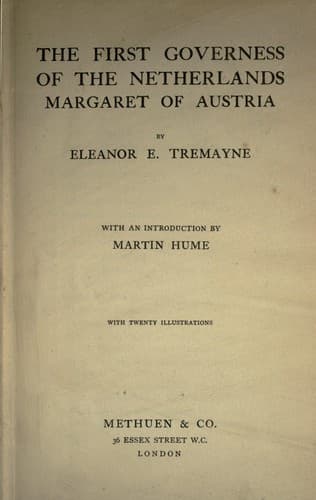
The First Governess of the Netherlands, Margaret of AustriaTremayne, Eleanor E.
History
The First Governess of the Netherlands, Margaret of Austria
Tremayne, Eleanor E.
Margaret, of Austria, Regent of the Netherlands, 1480-1530; Netherlands -- History -- Charles V, 1506-1555
The meeting of the Field of the Cloth of Gold, where Francis I. tried
by every means in his power to ingratiate himself with the English
king, was hardly over when Charles started for Gravelines to try and
efface the impression produced by his rival. Gravelines was a small
place, ill-fitted for the reception of kings, but Charles had
different methods than those employed by Francis, and he succeeded in
confirming himself in his uncle's good graces by showing him the most
courteous deference, and flattering his vanity in offering that he
should act as arbitrator in any differences which might arise between
Spain and France. Henry and Francis had already signed a treaty on the
6th of June whereby it was settled that the Dauphin should marry the
Princess Mary; but on the 14th of July another treaty was secretly
arranged in which the French alliance was indefinitely postponed, and
Charles's marriage with Mary agreed upon, although at the time he was
pledged to marry the French Princess Charlotte. Wolsey was largely
responsible for this change in affairs, for he was now bidding high
for the emperor's favour, though outwardly he still kept on good terms
with Francis.
The Chronicle of Calais gives an interesting account of Henry's
meeting with Charles at Gravelines on the 10th of July 1520. Margaret
accompanied her nephew, and together, with a brilliant following of
lords and ladies, the two monarchs and the regent journeyed to Calais.
Within the town a large tent had been erected intended for a
banqueting-hall, the seats arranged in tiers and draped with rich
tapestries. The roof painted to represent the sky with sun, moon,
stars, and clouds; but a great storm of wind and rain arose, and
during the night the great tent, with all its fine decorations and
tapestries, was blown down and ruined.
The two kings spent four days together, first at Gravelines and then
at Calais, when, after taking an affectionate farewell of each other,
they parted; Charles and Margaret journeying by slow stages towards
Aix-la-Chapelle, which, by a decree of the Golden Bull, had been
chosen as the scene of the emperor's coronation.
At Maestricht he reappointed Margaret as regent, and gave her a
Council presided over by Philippe de Bourgogne, Bishop of Utrecht, and
Érard de la Marck, Bishop of Liége. The Council of Malines, the Court
of Holland, and the tribunals of the other provinces were henceforth
made subordinate to the Council of the Regency established by the
emperor. This arrangement infringed the privileges of these bodies,
but Charles, deaf to their protests, abolished all privileges which
were contrary to this new régime. In order to put an end to petty
squabbles and ensure an equal protection to all, he gave, before
starting for Germany, the command of the army to Count Henry III. of
Nassau. Accompanied by Margaret he then left Maestricht and passed a
night at the castle of Wettheim.
Public-domain text, read in full here on John Shaqi.
Reviews
Reviews
No reviews yet
Be the first to share your thoughts on this work.
Elsewhere in the archive
Join the Discussion
Join the discussion
Sign in to leave a comment or review.
Sign InorCreate an account