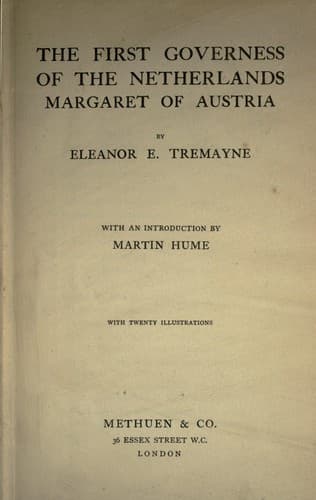
The First Governess of the Netherlands, Margaret of AustriaTremayne, Eleanor E.
History
The First Governess of the Netherlands, Margaret of Austria
Tremayne, Eleanor E.
Margaret, of Austria, Regent of the Netherlands, 1480-1530; Netherlands -- History -- Charles V, 1506-1555
Charles's election had called forth much enthusiasm in Germany. The
towns he passed through gave him a hearty welcome, for they looked to
him to restore order and redress their grievances.
On the 22nd of October he made his state entry into Aix-la-Chapelle,
where the electors of Mayence, Cologne, and Trèves, and the
ambassadors of the Duke of Saxony and the Margrave of Brandenburg had
arrived the day before. Charles had been elected emperor on June the
28th, 1519; but it was not until October 23rd, 1520, that he was
crowned at Aix. There in the church of Notre-Dame, in presence of a
vast assembly, with every detail of gorgeous ceremonial, the crown of
Charlemagne was placed upon his head; he swore to uphold the Catholic
faith, defend the Church, administer justice, maintain the rights of
the empire, recover its lost possessions, and render due obedience to
the Pope and the Roman Church. The Archbishop of Cologne, turning to
the assembled crowd, asked the German people if they would swear
fealty to their prince and uphold his government. A loud assent was
given. 'Charles was then anointed on his head, breast, arms and hands,
clothed in the deacon's robe of Charlemagne, and girt with the great
emperor's sword, crowned with his golden crown, and then with ring on
finger and ball and sceptre in hand, he was led to the stone seat of
empire.'[70]
[70] E. Armstrong, _The Emperor Charles V._
The next day the Archbishop of Mayence proclaimed that Charles had
assumed the title of Roman Emperor Elect. His coronation as Emperor
and King of Lombardy did not take place until 1530, when he was
crowned at Bologna by Pope Clement VII.
On November 1st he summoned the States to meet at Worms, and in
January 1521 travelled thither to be present at the Diet, where he and
Martin Luther met face to face for the first and last time.
CHAPTER XI
REVOLT OF THE DUKE OF BOURBON
Almost at the same time that Charles was crowned at Aix, the most
enterprising and accomplished of the Turkish sultans, Solyman the
Magnificent, ascended the Ottoman throne. The world has seldom seen
such a brilliant constellation of rulers as now filled the principal
thrones of Europe. Leo X., Charles V., Francis I., Henry VIII., and
Solyman the Magnificent each possessed talents which would have made
them conspicuous in any age, but which together made the history of
Europe during the first half of the sixteenth century peculiarly
interesting.
After his coronation, Charles returned to Brussels with Margaret. For
some time past alarming news had reached him from his regent in Spain,
where open rebellion had now broken out. Adrian of Utrecht was quite
unequal to the task of coping with the insurgents, and first Medina
del Campo, then Valladolid, and lastly Tordesillas (where Queen Joanna
was confined) fell into the hands of the rebels. The great seal and
state papers were seized, Adrian narrowly escaped being taken prisoner
with his Council, and only saved himself by flight.
Public-domain text, read in full here on John Shaqi.
Reviews
Reviews
No reviews yet
Be the first to share your thoughts on this work.
Elsewhere in the archive
Join the Discussion
Join the discussion
Sign in to leave a comment or review.
Sign InorCreate an account