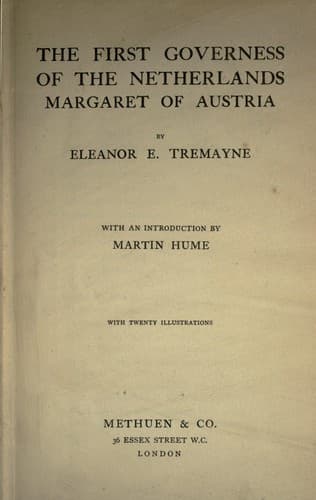
The First Governess of the Netherlands, Margaret of AustriaTremayne, Eleanor E.
History
The First Governess of the Netherlands, Margaret of Austria
Tremayne, Eleanor E.
Margaret, of Austria, Regent of the Netherlands, 1480-1530; Netherlands -- History -- Charles V, 1506-1555
The emperor replied from Pampeluna on November 27th: 'The principal
point is the advancement of the cardinal (Wolsey) to the papal
dignity. We have always desired, and with most sincere good feeling
and intention have wished to promote this to the utmost of our power,
having full recollection how we and the king, our good father and
brother, being at Windsor, opened to him our minds on this subject,
exhorting him to think of it, and promising our best services in his
assistance, because it appeared to us that his promotion and election
would be attended with great good to Christendom, and advantage to
our common interest.... We firmly believe that the Cardinal de Medicis
will give his assistance to the Sieur Legate, from the little chance,
we are informed, of his own success; and we well know and acknowledge
how cordially and sincerely madame, our good aunt, is occupied in this
affair, not only in her own name, but in ours. We entertain a good
hope, therefore, that all these efforts will prosper, and are
anxiously expecting favourable news which has been hitherto retarded
on account of the tempestuous weather at sea.'
On the 15th of December the emperor writes to De Praet: 'We have here
received the news by a letter from the Marquis de Finale that, on the
19th of November, Cardinal de Medicis was elected Pope.... You will
do well to communicate the above to the seigneurs, the king, and the
cardinal, advertising them that our ambassador, the Duke of Sessa, had
written to inform us that he was doing everything in his power, and
with the utmost diligence, to influence the votes of the Conclave in
favour of the Sieur Legate.'[90]
[90] W. Bradford.
It certainly appears from the above correspondence that Charles used
all his influence in Wolsey's favour in both this and the former
election, but the cardinal himself chose to consider otherwise, and
from this date he visibly cooled in his friendship, and though
outwardly affecting to rejoice in the Cardinal de Medicis' elevation,
he never forgave the emperor his supposed duplicity.
CHAPTER XII
CAPTURE OF FRANCIS I.
On September the 24th, 1524, Margaret's youngest niece, Katharine, who
had lived most of her life shut up with her mad mother in the gloomy
palace of Tordesillas, was married to John III., King of Portugal. The
marriage took place at Anyaguia, in the presence of Charles, who had
but lately recovered from a bad attack of fever. In a letter to the
Duke of Bourbon on September 5th, he says: 'Regarding my own person, I
would most willingly have gone to Barcelona according to your wish, if
my affairs had permitted me to do so. But I must first conclude the
marriage of my sister, Madame Katharine, and despatch some affairs of
this kingdom. Besides, I have for several days been suffering from an
intermittent fever, which has hindered me from attending much to
business. The said fever is, however, much diminished, and I hope,
with God's help, to be soon restored to health!...'[91]
Public-domain text, read in full here on John Shaqi.
Reviews
Reviews
No reviews yet
Be the first to share your thoughts on this work.
Elsewhere in the archive
Join the Discussion
Join the discussion
Sign in to leave a comment or review.
Sign InorCreate an account