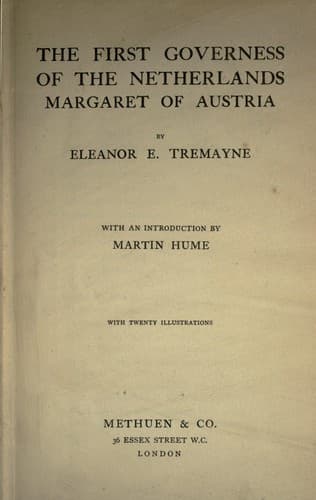
The First Governess of the Netherlands, Margaret of AustriaTremayne, Eleanor E.
History
The First Governess of the Netherlands, Margaret of Austria
Tremayne, Eleanor E.
Margaret, of Austria, Regent of the Netherlands, 1480-1530; Netherlands -- History -- Charles V, 1506-1555
About this time Margaret seems to have conceived the idea that it
would be better for the interests of all concerned if the arrangements
for the peace were made by ladies only, and she accordingly proposed
to the emperor that she should meet her sister-in-law Louise of Savoy
at a neutral town and discuss the conditions with her. In a letter to
M. de Rosymboz, her chief steward, dated Malines, 3rd of January 1529,
containing instructions to be laid before the emperor, Margaret gives
her reasons for this suggestion, and says:--'First, that the
bitterness of the reproaches written and spoken on either side were
such that ill-will and hatred were the inevitable consequences. The
hostilities also which ensued were so fierce that neither of the two
sovereigns could compromise his dignity by being the first to talk of
reconciliation, a challenge having been given and accepted for
settling the differences and disputes by single combat. On the other
hand, how easy for ladies... to make the first advances in such an
undertaking! Secondly, that it is only by a mutual forgiveness of all
offences, and the total oblivion of the causes of the war, and of
everything that had passed in writing concerning them, that the idea
of peace could be entertained. This could not be thought of or
proposed by the princes without a sacrifice of what they held most
precious, their honour; but ladies might well come forward in a
measure for submitting the gratification of private hatred and revenge
to the far nobler principle of the welfare of nations. Thirdly, were
the King of France to conduct negotiations with the emperor, it would
be necessary for him to act with especial reference to allies and
co-operators, the Venetians, Florentines, etc., and here a difficulty
would arise in effecting a reconciliation with the emperor, not to be
surmounted without the probability of some stain upon his honour; but
the act of the Lady of Angoulême, his mother, would in such case take
away all responsibility on the part of the king, whilst a similar
advantage would present itself to the emperor in silencing the
complaints of his friends, who might make objections to the terms of
peace. Again, in the event of any of the great powers being called in
as mediators in a negotiation, such as England or the Pope, their own
particular interest it is probable would be too much considered, and
something perhaps required in little territorial concessions as the
price of their interference; whilst the intervention proposed could be
subject to no such inconvenience; as the mother of the king and the
aunt of the emperor, who regarded him as her son as well as heir,
would keep in view one sole object which they had mutually at
heart--the general good of Europe, in the reconciliation of these two
great princes.'[135]
[135] W. Bradford.
Public-domain text, read in full here on John Shaqi.
Reviews
Reviews
No reviews yet
Be the first to share your thoughts on this work.
Elsewhere in the archive
Join the Discussion
Join the discussion
Sign in to leave a comment or review.
Sign InorCreate an account