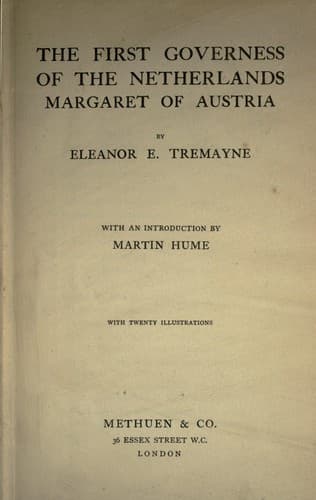
The First Governess of the Netherlands, Margaret of AustriaTremayne, Eleanor E.
History
The First Governess of the Netherlands, Margaret of Austria
Tremayne, Eleanor E.
Margaret, of Austria, Regent of the Netherlands, 1480-1530; Netherlands -- History -- Charles V, 1506-1555
To these wise arguments the emperor lent a willing ear, and invested
Margaret with full powers to treat with Louise of Savoy; and chose the
neutral town of Cambray as their meeting-place.
On May the 15th Margaret wrote to Jehan de la Sauch from Brussels,
whom she had sent on an embassy to England, bidding him tell King
Henry how often she had been requested by Louise of Savoy to listen to
overtures of peace. She had informed the emperor of the said overtures
through Rosymboz, her chief steward, and her secretary, Des Barres,
whom she had sent to Spain; and the emperor, not wishing to be an
obstacle to the said peace, sent her at once full powers to treat with
all Christian princes in general and with King Francis and his mother
in particular. This fact having been communicated to the Duchess of
Angoulême, measures had been taken to appoint a time and place wherein
the preliminaries of peace might be at once discussed and settled.
'She has no doubt,' she says, 'that King Henry will be glad to hear
the news, and will help to the utmost of his power in establishing
peace. For her part she need hardly say how glad she will be to labour
for so meritorious a purpose.' Maistre le Sauch is ordered to return
as soon as possible after delivering his embassy and report every word
the king and Wolsey may say on this occasion, and also what impression
the idea of the proposed meeting has produced on each of them.[136]
[136] _Calendar of Spanish State Papers._
On May the 26th Margaret wrote a long letter to the emperor in cipher
from Brussels, informing him that she had, with the advice of her
Council, agreed to meet Louise of Savoy on the 15th of the following
June at Cambray, and there discuss with her the preliminaries of a
lasting peace, which she (Margaret) had no doubt would be easily
obtained, provided the French king felt disposed to be as reasonable
as the emperor. She also said it was important to keep on good terms
with the English, as their assistance would certainly be required with
regard to the indemnity and the debts. And for this end Maistre Jehan
le Sauch has been sent to inform King Henry of the proposed meeting,
stating that nothing shall be negotiated without his being comprised
in it.... Respecting the emperor's visit to Italy (for his
coronation), the arrangement of which has given much pleasure to all
his faithful vassals and servants, she hopes that he will provide
himself with plenty of means, money, provisions and men, for money
cannot be procured in Italy, and as to reinforcements from Germany, it
will be next to impossible to procure any under two or three months'
notice.... In short, all things considered and 'subject to the
emperor's superior wisdom,' her opinion is that the embarkation ought
to be delayed until after the negotiations at Cambray are concluded,
for if the meeting takes place and is brought to a happy conclusion,
the emperor will be able to carry out his plans at less cost and with
Public-domain text, read in full here on John Shaqi.
Reviews
Reviews
No reviews yet
Be the first to share your thoughts on this work.
Elsewhere in the archive
Join the Discussion
Join the discussion
Sign in to leave a comment or review.
Sign InorCreate an account