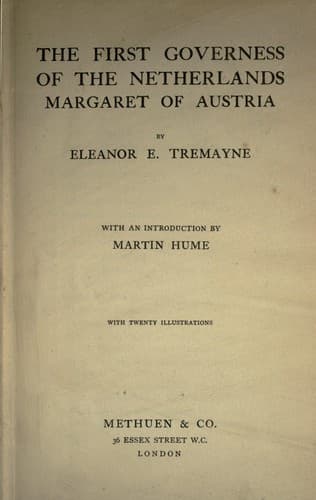
The First Governess of the Netherlands, Margaret of AustriaTremayne, Eleanor E.
History
The First Governess of the Netherlands, Margaret of Austria
Tremayne, Eleanor E.
Margaret, of Austria, Regent of the Netherlands, 1480-1530; Netherlands -- History -- Charles V, 1506-1555
After his coronation at Bologna the emperor continued his progress
through Trent, Bötzen, Innsbruck, to Augsburg, where he attended the
Diet which opened on June the 20th, 1530. There he met Melanchthon and
listened to his famous confession, and the long arguments which
followed on religious questions. Lutheranism was rapidly spreading in
Germany, but the emperor was powerless to prevent it. Charles remained
at Augsburg until November 23rd, and then continued his journey
towards the Netherlands, where Margaret was anxiously awaiting him;
but she and her beloved nephew were destined never to meet again on
earth, for when he reached Cologne he received the news of her death.
For some time past Margaret seems to have cherished the hope of
retiring to the Convent of the Annunciation which she had founded
outside the 'Porte des Anes' at Bruges, and spending the rest of
her days there in quiet seclusion. From Malines she wrote to the
Mother Superior:--'Ma Mère, ma mie,--I have ordered the bearer of
this, whom you know well, to give you news of me, and tell you of my
good resolution for some days past, and also inquire how you are,
which I hope is as well as you could wish for me. My hope is in the
good God and his glorious Mother, who will help and keep you for
better things. I have given him (the bearer) a memorandum for you, and
the Pater, your good father, which is from my own hand; from this you
will learn my intention. I desire that it shall not get talked about
('n'en soit faict grant bruit'), and for good reason, and with this I
will end, begging you to recommend me to our good father's prayers,
and also to all my good daughters, praying the Creator and His blessed
Mother to give His grace to you and also to me.--Your good daughter,
MARGARET.'
Then follows the memorandum to Estienne, her _valet de chambre_,
concerning what he is to say to the Pater and the Mère Ancille:[147]
'First, that I wish above all to put my religious (community) in such
a state that they will never be in great poverty, but will be able to
live without begging; and I wish to know... if more money is needed,
and if so, how much, that they may not be stinted; for with God's help
I will see to all; and every other thing that they desire, they must
let me know, for I intend to make there a good end, with the help of
God and our good Mistress, His glorious Mother.
[147] The Mother Superior was called 'la Mère Ancille,' a term of
humility, from 'Ancilla,' servant.
Public-domain text, read in full here on John Shaqi.
Reviews
Reviews
No reviews yet
Be the first to share your thoughts on this work.
Elsewhere in the archive
Join the Discussion
Join the discussion
Sign in to leave a comment or review.
Sign InorCreate an account