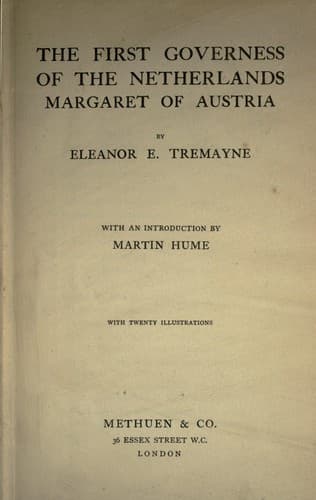
The First Governess of the Netherlands, Margaret of AustriaTremayne, Eleanor E.
History
The First Governess of the Netherlands, Margaret of Austria
Tremayne, Eleanor E.
Margaret, of Austria, Regent of the Netherlands, 1480-1530; Netherlands -- History -- Charles V, 1506-1555
'Amongst other things say to the Mère Ancille, my good mother, that I
beg her to make all my good daughters pray for the purpose which I
have always told her; for the time approaches, since the emperor is
coming, to whom, with God's help, I will render a good account of the
charge and government which he has pleased to give me; and this done,
I shall give myself up to the will of God and of our good Mistress,
begging you, my good Mother, "ma mie," that I may not be forgotten by
yours, and always remain your good daughter, MARGARET.'
Concerning the death of the Regent of the Netherlands very little is
authentically known, but from a MSS. in the archives at Ain, written
by an Augustine monk, the following account is found:--'Early on the
morning of the 15th of November, before rising, Margaret asked one of
her ladies, Magdalen of Rochester, for a glass of water. The maid of
honour brought her the drink in a crystal goblet, but in taking it
back Magdalen unluckily let it fall near the bed, where it broke in
several pieces. She carefully picked up all the fragments she could
see, but one piece lay hidden in Margaret's high-heeled embroidered
slipper. When the princess got up a few hours later, she put her bare
feet into the slippers, and tried to walk towards the fire, but
immediately felt a sharp pain in the sole of her left foot. On
examination it was found that a piece of broken glass was in the foot;
this was at once extracted, but the wound remained, and bled very
little. Margaret, who was always plucky, soon thought no more of the
accident, and neglected the wound. A few days later, however, her leg
became greatly inflamed, and she suffered much pain. At last, on the
22nd, doctors were called in, and a consultation was held. They found
that gangrene had already set in, and decided that the only way to
save her life was to amputate the foot. The next day, the 23rd, they
commissioned M. de Montécute, her almoner and confessor, to break the
news to her, and prepare her for the terrible operation. She was
naturally much surprised and upset, but with great fortitude consented
to undergo the dreadful ordeal. For four days she shut herself up, and
would see no one, spending the time in prayer and confession; on the
morning of the 27th she received the Sacrament, and on the 28th and
29th she arranged her earthly affairs, and added a codicil to the will
she had made in 1508. This codicil did not, however, fundamentally
alter her former testament. She left Charles her sole heir, with the
exception of a few bequests, such as 'one of her best rings' to his
brother Ferdinand, and legacies to her old officers and servants. 'And
in order not to abolish the name of the House of Burgundy... my said
lady begs and implores the Lord Emperor to be pleased to keep in his
own hands the said county of Burgundy, and its dependencies, as long
as he lives, and after his death to leave it to the one of his
Public-domain text, read in full here on John Shaqi.
Reviews
Reviews
No reviews yet
Be the first to share your thoughts on this work.
Elsewhere in the archive
Join the Discussion
Join the discussion
Sign in to leave a comment or review.
Sign InorCreate an account