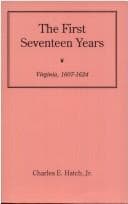
The First Seventeen Years: Virginia 1607-1624Hatch, Charles E., Jr.
History
The First Seventeen Years: Virginia 1607-1624
Hatch, Charles E., Jr.
Virginia -- History -- Colonial period, ca. 1600-1775
It was obvious to everyone that there were too many men for all to
remain at Jamestown. John Martin was sent to attempt a settlement at
Nansemond, on the south side of the James below Jamestown, while Captain
Francis West, brother of Lord De La Warr, was sent to settle at the
falls of the James. Returning to Jamestown after an inspection tour at
the falls, Captain Smith was injured by burning gunpowder and
incapacitated. Ratcliffe, Archer, and Martin seemingly used this
opportunity to depose him and to compel him to return to England to face
their charges against him as had been the fate of previous presidents.
These three men, failing to agree on a replacement from their own
number, persuaded George Percy to accept the position of president.
Percy was in command during the terrible winter that followed.
The winter of 1609-10 has been described through the years as the
"starving time," seemingly, an accurate description. It saw the
population shrink from 500 to about sixty as a result of disease,
sickness, Indian arrows, and malnutrition. It destroyed morale and
reduced the men to scavengers stalking the forest, fields, and woods for
anything that might be used as food. When spring came there was little
spirit left in the settlement. It would seem unjust to attribute the
disaster to Percy, who did what he could to ameliorate conditions by
attempting trade and keeping the men busy. The "starving time" appears
to have been caused by an accumulation of circumstances not the least of
them being internal dissension and the now open hostility of the Indian.
The heavy use of force and armed persuasion in dealing with them was
bound to have its effect. It cut off the badly needed supply of corn and
other Indian foods.
A CRITICAL HOUR
In May 1610, the hearts of the weary settlers were gladdened when Sir
Thomas Gates, their new governor, sailed into the James. For about a
year he and the survivors of the wreck of the _Sea Venture_ had labored
in Bermuda to make possible the continuation of their voyage to
Virginia. For the purpose they built two small boats, the _Patience_ and
the _Deliverance_. It was not a pleasant sight that greeted them at
Jamestown. Ruin and desolation were everywhere. Gates, with his Council,
on July 7, 1610, wrote that Jamestown seemed "raither as the ruins of
some auntient [for]tification, then that any people living might now
inhabit it...."
Gates promptly distributed provisions, such as he had, and introduced a
code of martial law, the code that was strengthened later by De La Warr
and made famous by its strict enforcement during the governorship of Sir
Thomas Dale. After surveying the condition of the settlement and
realizing that the supplies he had brought would not last three weeks,
Gates took counsel with the leaders. They decided to abandon the
settlement. On June 7, 1610, the settlers, except some of the Poles and
Dutchmen who were with Powhatan, boarded the ship, left Jamestown, and
started down the James.
Public-domain text, read in full here on John Shaqi.
Reviews
Reviews
No reviews yet
Be the first to share your thoughts on this work.
Join the Discussion
Join the discussion
Sign in to leave a comment or review.
Sign InorCreate an account