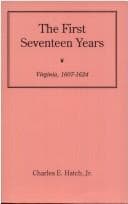
The First Seventeen Years: Virginia 1607-1624 — John Shaqi
The First Seventeen Years: Virginia 1607-1624Hatch, Charles E., Jr.
History
The First Seventeen Years: Virginia 1607-1624
Hatch, Charles E., Jr.
Virginia -- History -- Colonial period, ca. 1600-1775
Church affairs came in for considerable regulation. One act required
that a place be set aside for the worship of God in each and every
plantation, a place or "roome sequestred for that purpose" as well as "a
place sequestred onlye to the buryall of the dead." A fine, one pound
of tobacco for one Sunday but fifty pounds for a month of absences, was
imposed for missing the Sunday service. Ministers were exhorted to look
after their charges and the people were not to "disparage" their
ministers without "sufficient proofe." Payment of the minister's salary
was to be insured and there were regulations against "swearinge and
drunkennes." A formal order was passed that March 22, the date of the
massacre of two years before, be "solemnized as [a] hollidaye." In
matters of church conformity the action was specific, "That there be an
uniformitie in our Church as neere as may be, to the canons in Englande
both in [substance] and circumstance and that all persons yeeld redie
obedience unto them under pain of censure."
Government organization and operation was spelled out in a number of
instances. To meet the needs of a growing and spreading population
special courts were set up for Elizabeth City and Charles City. At least
in cases involving no more than 100 pounds of tobacco and for petty
offences, it would not be necessary to journey to Jamestown. It was
further ordered that all private holdings be duly surveyed, bounded, and
recorded. A public "grainary" was ordered to be established in each
parish. Control of trade was sought by specifying that no ships should
"break boulke [bulk] or make privatt sales of any comodities" before
reaching Jamestown. Taxes were not ignored either for a levy of ten
pounds of tobacco, already the common currency it appears, was laid on
each male above 16 years of age to help defray the "publique depte
[debt]." Lest it be forgotten, it was enacted that obedience was
required "to the presente government."
Old planters were given special exemption from public service, "they and
theire posteritie," while Burgesses were rendered exempt from seizure
during Assembly time. "Persones of qualitie" when found delinquent, it
was stated, could be imprisoned if not fit to take corporal punishment.
It is of note that service to the Governor, or the public, was made
contingent on Assembly consent. Of particular interest, too, was the
action on the principle of taxation. It was bold, indeed, at this time
for the Assembly to declare that;
The Governor shall not laye any taxes or impositiones uppon
the Colony, theire landes or comodities otherwi[se] then by
the awthoritie of the Generall Assemblie, to be levied and
imployed as the saide Assembly shall appoint.
This was an early word on taxation, but it was to be far from the last
word in the next century and a half.
Public-domain text, read in full here on John Shaqi.
Reviews
Reviews
No reviews yet
Be the first to share your thoughts on this work.
Join the Discussion
Join the discussion
Sign in to leave a comment or review.
Sign InorCreate an account