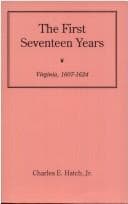
The First Seventeen Years: Virginia 1607-1624Hatch, Charles E., Jr.
History
The First Seventeen Years: Virginia 1607-1624
Hatch, Charles E., Jr.
Virginia -- History -- Colonial period, ca. 1600-1775
This, along with Martin's Hundred and Argall's settlement, was among the
first particular plantations to be established in Virginia and was
founded and promoted by the "Society of Smyth's Hundred." It took its
name from Sir Thomas Smith who was treasurer of the Virginia Company and
a heavy investor. When he sold his interest in 1620 to his successor,
the Earl of Southampton, the designation was changed from Smith's to
Southampton Hundred. The initial grant was for some 80,000 acres and it
was located on the north shore of the James between the Chickahominy
River and the Weyanoke territory.
The first settlers to come over in the venture appear to have arrived in
the ship _George_ in 1617. In 1618 it was planned to send another 35 and
supplies were arranged including "Tooles for a brickyard" and "A mill to
grind" tools. The items enumerated can be found in the _Records of the
Virginia Company of London_ in Volume III, pages 95-96. From a good
start it seemingly became, for a time, the leading plantation on the
James. When Yeardley arrived as Governor he became interested in this
project in which he obviously had a financial stake at least to the
extent of bringing "out of England at my chardge 25 men this year [1619]
to furnish Smyth hundred...." Yeardley wrote on April 29, 1619, that the
plantation was "alltogether destitute of cowes." He asked that more be
sent and that authority be sought to purchase as they were available. He
hoped to get in the Colony "as many as will sett up 3 ploughs at Smythes
Hundred, for we have there great store of good cleered grounds." He was
disappointed in not having a good tobacco crop but drought and other
things had prevented it. "I cannot expect much tobako our cheifest care
must be for corne."
When representatives were chosen for the Assembly in 1619, Capt. Thomas
Graves and Walter Shelley went up to Jamestown from Smith's Hundred.
Already a church had been founded here. It was St. Marys Church to which
Mary Robinson was a benefactor having made possible a communion cup, a
plate, a carpet, an altar cloth, "one surplisse" and other ornaments and
hangings to the value of twenty pounds. The Society of Smith's Hundred
became interested, too, in the rearing of Indian children in the
Christian way when another benefactor assured financial support. It was
agreed that arrangements would be found for all not accommodated at
Berkeley and Martin's hundreds and elsewhere. This particular plantation
was among those to be encouraged by Company and Colony. Products they
reaped could be returned to their own adventurers.
Public-domain text, read in full here on John Shaqi.
Reviews
Reviews
No reviews yet
Be the first to share your thoughts on this work.
Join the Discussion
Join the discussion
Sign in to leave a comment or review.
Sign InorCreate an account