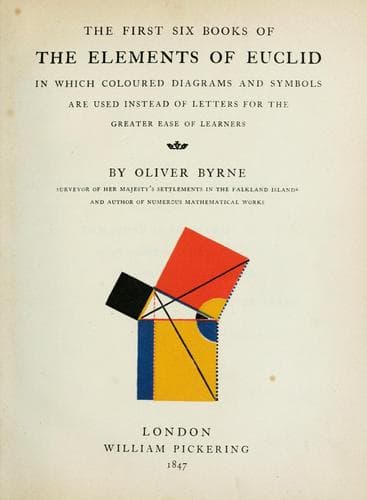
The First Six Books of the Elements of EuclidEuclid
Science
The First Six Books of the Elements of Euclid
Euclid
Euclid's Elements; Mathematics, Greek
When two quantities are incommensurable, such as the diagonal and the side of a square,
although their ratio is not equal to that of any two commensurable numbers, yet a series of pairs of
fractions can be found whose difference is continually diminishing, and which ultimately becomes
indefinitely small; such that the ratio of the incommensurable quantities is greater than
one, and less than the other fraction of each pair. These fractions are called convergents.
By their means we can approximate as nearly as we please to the exact value of the
ratio. In the case of the diagonal and the side of a square, the following are the pairs of
convergents:—
and the ratio is intermediate to each pair. It is evident we may continue the series as far as we
please. Now if we denote the first of any of the foregoing pairs of fractions by , the second will be
; and in general, in the case of two incommensurable quantities, two fractions and
can always be found, where n can be made as large as we please, one of which is less and the
other greater than the true value of the ratio. For let a and b be the incommensurable
quantities; then, evidently, we cannot find two multiples na, mb, such that na = mb. In this
case, take any multiple of a, such as na, then this quantity must lie between some two
consecutive multiples of b, such as mb, and (m + 1)b; therefore is greater than unity, and
less than unity. Hence lies between and . Now, since the difference
between and namely, becomes small as n increases, we see that the difference
between the ratio of two incommensurable quantities and that of two commensurable
numbers m and n can be made as small as we please. Hence, ultimately, the ratio of
incommensurable quantities may be regarded as the limit of the ratio of commensurable
quantities.
5. The two terms of a ratio are called the antecedent and the consequent. These correspond to
the numerator and the denominator of a fraction. Hence we have the following definition:—“A
ratio is the fraction got by making the antecedent the numerator and the consequent the
denominator.”
6. The reciprocal of a ratio is the ratio obtained by interchanging the antecedent and the
consequent. Thus, 4 : 3 is the reciprocal of the ratio 3 : 4. Hence we have the following
theorem:—“The product of a ratio and its reciprocal is unity.”
7. If we multiply any two numbers, as 5 and 7, by any number such as 4, the products 20, 28 are
called equimultiples of 5 and 7. In like manner, 10 and 15 are equimultiples of 2 and 3, and 18 and
30 of 3 and 5, &c.
Public-domain text, read in full here on John Shaqi.
Reviews
Reviews
No reviews yet
Be the first to share your thoughts on this work.
Elsewhere in the archive
Join the Discussion
Join the discussion
Sign in to leave a comment or review.
Sign InorCreate an account