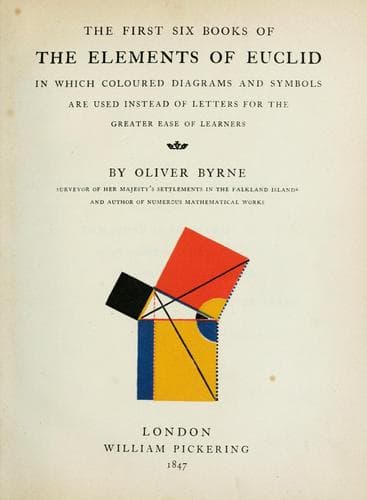
The First Six Books of the Elements of EuclidEuclid
Science
The First Six Books of the Elements of Euclid
Euclid
Euclid's Elements; Mathematics, Greek
v. The first of four magnitudes has to the second the same ratio which the third
has to the fourth, when any equimultiples whatsoever of the first and third being
taken, and any equimultiples whatsoever of the second and fourth, if, according as
the multiple of the first is greater than, equal to, or less than the multiple of the
second, the multiple of the third is greater than, equal to, or less than the multiple of
the fourth.
vi. Magnitudes which have the same ratio are called proportionals. When four
magnitudes are proportionals, it is usually expressed by saying, “The first is to the
second as the third is to the fourth.”
viii. Analogy or proportion is the similitude of ratios.
We have given the foregoing definitions in the order of Euclid, as given by Simson, Lardner, and
others;2 2Except that viii. is put before vii., because it relates, as v. and vi., to the equality of ratios,
whereas vii. is a test of their inequality.
but it is evidently an inverted order; for vi. viii. are definitions of proportion, and v. is only a test
of proportion, and is not a definition but a theorem, and one which, instead of being taken for
granted, requires proof. The following explanations will give the student clear conceptions of their
meaning:—
1. If we take two ratios, such as 6 : 9 and 10 : 15, which are each equal to the same thing (in this
example each is equal to ), they are equal to one another (I. Axiom i.). Then we may write it
thus—
This would be the most intelligible way, but it is not the usual one, which is as
follows:—6 : 9 :: 10 : 15. In this form it is called a proportion. Hence a proportion consists of two
ratios which are asserted by it to be equal. Its four terms consist of two antecedents and
two consequents. The 1st and 3rd terms are the antecedents, and the 2nd and 4th the
consequents. Also the first and last terms are called the extremes, and the two middle terms the
means.
2. Since a proportion consists of two equal ratios, and each ratio can be written as a fraction,
whenever we have a proportion such as
we can write it in the form of two equal fractions. Thus:
Conversely, an equation between two fractions can be put into a proportion. By means of these
simple principles all the various properties of proportion can be proved in the most direct and easy
manner.
3. If we take the proportion a : b :: c : d, and multiply the first and third terms, each by m, and
second and fourth, each by n, we get the four multiples, ma, nb, mc, nd; and we want to
prove that if ma is greater than nb, mc is greater than nd; if equal, equal; and if less,
less.
Dem.—Since
a : b
:: c : d,
we have
= .
Hence, multiplying each by we get
= .
Public-domain text, read in full here on John Shaqi.
Reviews
Reviews
No reviews yet
Be the first to share your thoughts on this work.
Elsewhere in the archive
Join the Discussion
Join the discussion
Sign in to leave a comment or review.
Sign InorCreate an account