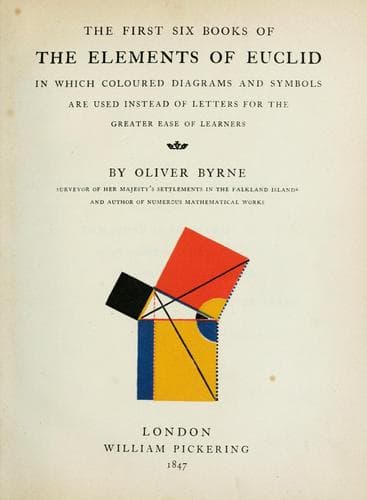
The First Six Books of the Elements of EuclidEuclid
Science
The First Six Books of the Elements of Euclid
Euclid
Euclid's Elements; Mathematics, Greek
4. If four magnitudes be continual proportionals, the ratio of 1st : 4th is equal to the cube of the
ratio of 1st : 2nd. This may be proved exactly like 3. Hence we see that what Euclid
calls triplicate ratio of two magnitudes is the ratio of their cubes, or the cube of their
ratio.
We also see that there is no necessity to introduce extraneous magnitudes for the purpose of
defining duplicate and triplicate ratios, as Euclid does. In fact, the definitions by squares and cubes
are more explicit.
xiii. In proportionals, the antecedent terms are called homologous to one another;
as also the consequents to one another.
If one proportion be given, from it an indefinite number of other proportions can be inferred,
and a great part of the theory of proportion consists in proving the truth of these derived
proportions. Geometers make use of certain technical terms to denote the most important of these
processes. We shall indicate these terms by including them in parentheses in connexion with the
Propositions to which they refer. They are useful as indicating, by one word, the whole enunciation
of a theorem.
Every Proposition in the Fifth Book is a Theorem.
PROP. I.—Theorem.
If any number of magnitudes of the same kind (a, b, c, &c.), be equimultiples
of as many others (a′, b′, c′, &c.), then the sum of the first magnitudes
(a + b + c, &c.) shall be the same multiple of the sum of the second which any
magnitude of the first system is of the corresponding magnitude of the second
system.
Dem.—Let m denote the multiple which the magnitudes of the first system are of
those of the second system.
Then we have a = ma′ (hyp.),
b = mb′,
c = mc′.
&c., &c.
Hence, by addition,
PROP. II.—Theorem.
If two magnitudes of the same kind (a, b) be the same multiples of another (c)
which two corresponding magnitudes (a′, b′) are of another (c′), then the sum of the
two first is the same multiple of their submultiple which the sum of their
corresponding magnitudes is of their submultiple.
Dem.—Let m and n be the multiples which a and b are of c.
Then we have
Therefore
Hence a + b is the same multiple of c that a′ + b′ is of c′.
This Proposition is evidently true for any number of multiples.
PROP. III.—Theorem.
If two magnitudes (a, b) be equimultiples of two others (a′, b′); then any
equimultiples of the first magnitudes (a, b) will be also equimultiples of the second
magnitudes (a′, b′).
Dem.—Let m denote the multiples which a, b are of a′, b′; then we have
Hence, multiplying each equation by n, we get
Hence, na, nb are equimultiples of a′, b′.
PROP. IV.—Theorem.
If four magnitudes be proportional, and if any equimultiples of the first and third be
taken, and any other equimultiples of the second and fourth; then the multiple of the
first : the multiple of the second :: the multiple of the third : the multiple of the
fourth.
Public-domain text, read in full here on John Shaqi.
Reviews
Reviews
No reviews yet
Be the first to share your thoughts on this work.
Elsewhere in the archive
Join the Discussion
Join the discussion
Sign in to leave a comment or review.
Sign InorCreate an account