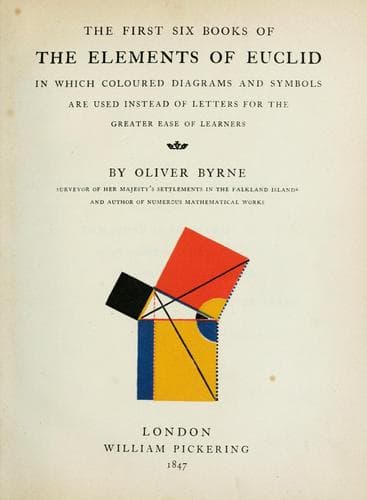
The First Six Books of the Elements of EuclidEuclid
Science
The First Six Books of the Elements of Euclid
Euclid
Euclid's Elements; Mathematics, Greek
This has the same fault as some of the others—it is not a definition, but an inference. It occurs
when the means in a proportion are equal, so that, in fact, there are four terms. As an illustration,
let us take the numbers 4, 6, 9. Here the ratio of 4 : 6 is , and the ratio of 6 : 9 is , so that 4, 6, 9
are continued proportionals; but, in reality, there are four terms, for the full proportion is
4 : 6 :: 6 : 9.
x. When three magnitudes are continual proportionals, the first is said to have to
the third the duplicate ratio of that which it has to the second.
xi. When four magnitudes are continual proportionals, the first is said to have to
the fourth the triplicate ratio of that which it has to the second.
xii. When there is any number of magnitudes of the same kind greater than two,
the first is said to have to the last the ratio compounded of the ratios of the
first to the second, of the second to the third, of the third to the fourth,
&c.
We have placed these definitions in a group; but their order is inverted, and, as we shall see,
Def. xii. is a theorem, and x. and xi. are only inferences from it.
1. If we have two ratios, such as 5 : 7 and 3 : 4, and if we convert each ratio into a fraction, and
multiply these fractions together, we get a result which is called the ratio compounded of the two
ratios; viz. in this example it is , or 15 : 28. It is evident we get the same result if we multiply
the two antecedents together for a new antecedent, and the two consequents for a new
consequent. Hence we have the following definition:—“The ratio compounded of any
number of ratios it the ratio of the product of all the antecedents to the product of all the
consequents.”
2. To prove the theorem contained in Def. xii.
Let the magnitudes be a, b, c, d. Then the ratio of
1st : 2nd = ,
2nd : 3rd = ,
3rd : 4th = .
Hence the ratio compounded of the ratio of 1st : 2nd, of 2nd : 3rd, of 3rd : 4th
3. If three magnitudes be proportional, the ratio of the 1st : 3rd is equal to the square of the
ratio of the 1st : 2nd. For the ratio of the 1st : 3rd is compounded of the ratio of the 1st : 2nd, and
of the ratio of the 2nd : 3rd; and since these ratios are equal, the ratio compounded of them will be
equal to the square of one of them.
Or thus: Let the proportionals be a, b, c, that is, let a : b :: b : c; hence we have
And multiplying each by , we get
or a : c :: a2 : b2—that is, 1st : 3rd :: square of 1st : square of 2nd. Now, the ratio of 1st : 3rd is, by
Def. x., the duplicate ratio of 1st : 2nd. Hence the duplicate ratio of two magnitudes means the
square of their ratio, or, what is the same thing, the ratio of their squares (see Book
VI. xx.).
Public-domain text, read in full here on John Shaqi.
Reviews
Reviews
No reviews yet
Be the first to share your thoughts on this work.
Elsewhere in the archive
Join the Discussion
Join the discussion
Sign in to leave a comment or review.
Sign InorCreate an account