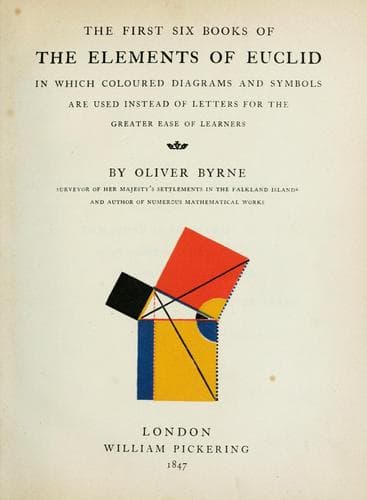
The First Six Books of the Elements of EuclidEuclid
Science
The First Six Books of the Elements of Euclid
Euclid
Euclid's Elements; Mathematics, Greek
1. Let a : b :: c : d, and let a be a multiple of b, then c is the same multiple of
d.
Dem.—Let a = mb, then = m;but = ; therefore = m, and c = md.
2. Let a = , then = ;
therefore = ,
Hence c = .
PROP. VII.—Theorem.
1. Equal magnitudes have equal ratios to the same magnitude.
2. The same magnitude has equal ratios to equal magnitudes.
Let a and b be equal magnitudes, and c any other magnitude.
Then 1. a : c :: b : c,
2. c : a :: c : b.
Dem.—Since a = b, dividing each by c, we have
therefore a : c :: b : c.
Again, since a = b, dividing c by each, we have
therefore c : a :: c : b.
Observation.—2 follows at once from 1 by Proposition B.
PROP. VIII.—Theorem.
1. Of two unequal magnitudes, the greater has a greater ratio to any third magnitude
than the less has; 2. any third magnitude has a greater ratio to the less of two unequal
magnitudes than it has to the greater.
1. Let a be greater than b, and let c be any other magnitude of the same kind,
then the ratio a : c is greater than the ratio b : c.
Dem.—Since a is greater than b, dividing each by c,
therefore the ratio a : c is greater than the ratio b : c.
2. To prove that the ratio c : b is greater than the ratio c : a.
Dem.—Since b is less than a, the quotient which is the result of dividing any
magnitude by b is greater than the quotient which is got by dividing the same
magnitude by a;
therefore is greater than .
Hence the ratio c : b is greater than the ratio c : a.
PROP. IX.—Theorem.
Magnitudes which have equal ratios to the same magnitude are equal to one another;
2. magnitudes to which the same magnitude has equal ratios are equal to one
another.
1. If a : c :: b : c, to prove a = b.
Dem.—Sincea : c :: b : c,
= .
Hence, multiplying each by c, we get a = b.
2. If c : a :: c : b, to prove a = b.
Dem.—Since c : a :: c : b,
by inversion, a : c :: b : c;
therefore a = b. [1].
PROP. X.—Theorem.
Of two unequal magnitudes, that which has the greater ratio to any third is the
greater of the two; and that to which any third has the greater ratio is the less of the
two.
1. If the ratio a : c be greater than the ratio b : c, to prove a greater than
b.
Dem.—Since the ratio a : c is greater than the ratio b : c,
Hence, multiplying each by c, we get a greater than b.
2. If the ratio c : b is greater than the ratio c : a, to prove b is less than
a.
Dem.—Since the ratio c : b is greater than the ratio c : a,
Hence 1 ÷ is less than 1 ÷,
that is, is less than .
Hence, multiplying each by c, we get
PROP. XI.—Theorem.
Ratios that are equal to the same ratio are equal to one another.
Public-domain text, read in full here on John Shaqi.
Reviews
Reviews
No reviews yet
Be the first to share your thoughts on this work.
Elsewhere in the archive
Join the Discussion
Join the discussion
Sign in to leave a comment or review.
Sign InorCreate an account