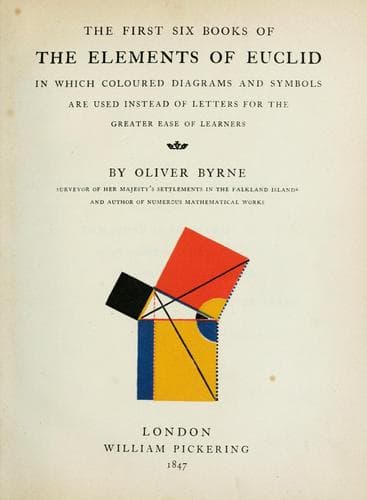
The First Six Books of the Elements of EuclidEuclid
Science
The First Six Books of the Elements of Euclid
Euclid
Euclid's Elements; Mathematics, Greek
Let a : b :: e : f, and c : d :: e : f, to prove a : b :: c : d.
Dem.—Since a : b :: e : f,
= .
In like manner,
= .
Hence
= [I., Axiom i.],
and
a :
b :: c : d.
PROP. XII.—Theorem.
If any number of ratios be equal to one another, any one of these equal ratios is
equal to the ratio of the sum of all the antecedents to the sum of all the
consequents.
Let the ratios a : b, c : d, e : f, be all equal to one another; it is required to prove
that any of these ratios is equal to the ratio a + c + e : b + d + f.
Dem.—By hypotheses,
Since these fractions are all equal, let their common value be r; then we
have
= r, = r, = r;
therefore a = br,
c = dr,
e = fr;
therefore a + c + e = (b + d + f)r.
Hence = r;
therefore = ,
and a : b :: a + c + e : b + d + f.
Cor.—With the same hypotheses, if l, m, n be any three multipliers,
a : b :: la + mc + ne : lb + md + nf.
PROP. XIII.—Theorem.
If two ratios are equal, and if one of them be greater than any third ratio, then
the other is also greater than that third ratio.
If a : b :: c : d, but the ratio of c : d greater than the ratio of e : f; then the ratio of
a : b is greater than the ratio of e : f.
Dem.—Since the ratio of c : d is greater than the ratio of e : f,
Again, since a : b :: c : d,
= ;
therefore is greater than .
or the ratio of a : b is greater than the ratio of e : f.
PROP. XIV.—Theorem.
If two ratios be equal, then, according as the antecedent of the first ratio is greater
than, equal to, or less than the antecedent of the second, the consequent of the first is
greater than, equal to, or less than the consequent of the second.
Let a : b :: c : d; then if a be greater than c, b is greater than d; if equal, equal; if
less, less.
Dem.—Since a : b :: c : d.
we have = ,
and multiplying each by we get
× = ×,
or = ;
therefore a : c :: b : d.
Hence, Proposition [A], if a be greater than c, b is greater than d; if equal, equal; and
if less, less.
PROP. XV.—Theorem.
Magnitudes have the same ratio which all equimultiples of them have.
Let a, b be two magnitudes, then the ratio a : b is equal to the ratio
ma : mb.
Dem.—The ratio a : b = , and the ratio of ma : mb = ; but since the value
of a fraction is not altered by multiplying its numerator and denominator by the
same number,
= ;
therefore a : b :: ma : mb.
PROP. XVI—Theorem.
If four magnitudes of the same kind be proportionals they are also
proportionals by alternation (alternando).
Let a : b :: c : d, then a : c :: b : d.
Dem.—Since a : b :: c : d,
and multiplying each by , we get
. = .,
Public-domain text, read in full here on John Shaqi.
Reviews
Reviews
No reviews yet
Be the first to share your thoughts on this work.
Elsewhere in the archive
Join the Discussion
Join the discussion
Sign in to leave a comment or review.
Sign InorCreate an account