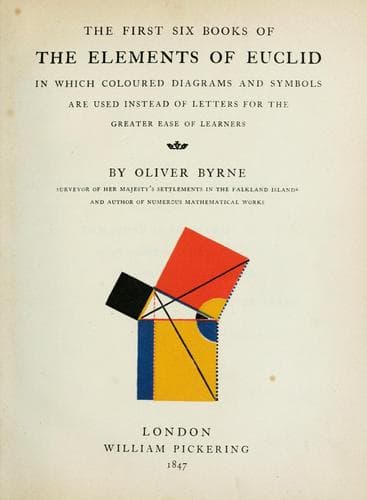
The First Six Books of the Elements of EuclidEuclid
Science
The First Six Books of the Elements of Euclid
Euclid
Euclid's Elements; Mathematics, Greek
Let a, b, c; a′, b′, c′ be the two sets of magnitudes, and let the ratio a : b = b′ : c′,
and b : c = a′ : b′. Then, if a be greater than, equal to, or less than c, a′ will be
greater than, equal to, or less than c′.
Dem.—Since a : b :: b′ : c′,
we have = .
In like manner, = .
Hence, multiplying = .
Therefore, if a be greater than c, a′ is greater than c′; if equal, equal; if less,
less.
PROP. XXII.—Theorem.
If there be two sets of magnitudes, which, taken two by two in direct order, have
equal ratios, then the first : the last of the first set :: the first : the last of the second
set (“ex aequali,” or “ex aequo”).
Let a, b, c; a′, b′, c′ be the two sets of magnitudes, and if a : b :: a′ : b′, and
b : c :: b′ : c′, then a : c :: a′ : c′.
Dem.—Since a : b :: a′ : b′,
we have =
In like manner, = .
Hence, multiplying, = .
Therefore a : c :: a′ : c′,
and similarly for any number of magnitudes in each set.
Cor. 1.—If the ratio b : c be equal to the ratio a : b, then a, b, c will be in
continued proportion, and so will a′, b′, c′. Hence [Def. xii. Annotation 3],
but = . [xxii.]
Therefore = .
Hence, if a : b :: a′ : b′,
a2 : b2 :: a′2 : b′2
Or if four magnitudes be proportional, their squares are proportional.
Cor. 2.—If four magnitudes be proportional, their cubes are proportional.
PROP. XXIII.—Theorem.
If there be two sets of magnitudes, which, taken two by two in transverse order, have
equal ratios; then the first : the last of the first set :: the first : the last of the second
set (“ex aequo perturbato”).
Let a, b, c; a′, b′, c′ be the two sets of magnitudes, and let the ratio a : b = b′ : c′,
and b : c = a′ : b′; then a : c :: a′ : c′.
Dem.—Since a : b :: b′ : c′,
we have = .
In like manner, = .
Hence, multiplying, = ;
therefore a : c :: a′ : c′,
and similarly for any number of magnitudes in each set.
This Proposition and the preceding one may be included in one enunciation, thus:
“Ratios compounded of equal ratios are equal.”
PROP. XXIV.—Theorem.
If two magnitudes of the same kind (a, b) have to a third magnitude (c)
ratios equal to those which two other magnitudes (a′, b′) have to a third
(c′), then the sum (a + b) of the first two has the same ratio to their third
(c) which the sum (a′ + b′) of the other two magnitudes has to their third
(c′).
Dem.—Since a : c :: a′ : c′,
we have = .
In like manner, = ;
therefore, adding, = .
Hence a + b : c :: a′ + b′ : c′.
PROP. XXV.—Theorem.
If four magnitudes of the same kind be proportionals, the sum of the greatest
and least is greater than the sum of the other two.
Let a : b :: c : d; then, if a be the greatest, d will be the least [xiv. and a]. It is
required to prove that a + d is greater than b + c.
Dem.—Since a : b :: c : d,
Public-domain text, read in full here on John Shaqi.
Reviews
Reviews
No reviews yet
Be the first to share your thoughts on this work.
Elsewhere in the archive
Join the Discussion
Join the discussion
Sign in to leave a comment or review.
Sign InorCreate an account