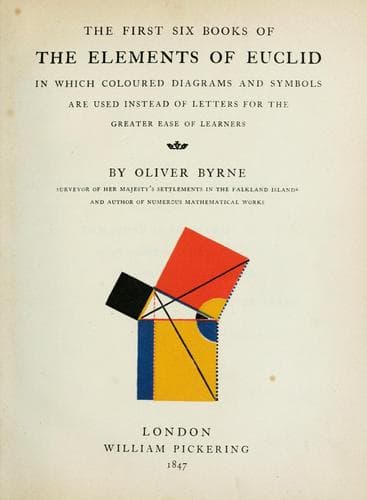
The First Six Books of the Elements of EuclidEuclid
Science
The First Six Books of the Elements of Euclid
Euclid
Euclid's Elements; Mathematics, Greek
a : c :: b : d [alternando];
therefore a : a − c :: b : b − d [E].;
but a is greater than b (hyp.),
therefore a − c is greater than b − d [xiv.].
Hence a + d is greater than b + c.
Questions for Examination on Book V.
1. What is the subject-matter of this book?
2. When is one magnitude said to be a multiple of another?
3. What is a submultiple or measure?
4. What are equimultiples?
5. What is the ratio of two commensurable magnitudes?
6. What is meant by the ratio of incommensurable magnitudes?
7. Give an Illustration of the ratio of incommensurables.
8. What are the terms of a ratio called?
9. What is a ratio of greater inequality?
10. What is a ratio of lesser inequality?
11. What is the product of two ratios called? Ans. The ratio compounded of these
ratios.
12. What is duplicate ratio?
13. What is Euclid’s definition of duplicate ratio?
14. Give another definition.
15. Define triplicate ratio.
16. What is proportion? Ans. equality of ratios.
17. Give Euclid’s definition of proportion.
18. How many ratios in a proportion?
19. What are the Latin terms in use to denote some of the Propositions of Book V.?
20. When is a line divided harmonically?
21. When a line is divided harmonically, what are corresponding pairs of points called?
Ans. Harmonic conjugates.
22. What are reciprocal ratios?
23. Give one enunciation that will include Propositions xxii., xxiii. of Book V.
Exercises on Book V.
Def. I.—A ratio whose antecedent is greater than its consequent is called a ratio of greater
inequality; and a ratio whose antecedent is less than its consequent, a ratio of lesser
inequality.
Def. II.—A right line is said to be cut harmonically when it is divided internally and externally
in any ratios that are equal in magnitude.
1. A ratio of greater inequality is increased by diminishing its terms by the same quantity, and
diminished by increasing its terms by the same quantity.
2. A ratio of lesser inequality is diminished by diminishing its terms by the same quantity, and
increased by increasing its terms by the same quantity.
3. If four magnitudes be proportionals, the sum of the first and second is to their difference as
the sum of the third and fourth is to their difference (componendo et dividendo).
4. If two sets of four magnitudes be proportionals, and if we multiply corresponding terms
together, the products are proportionals.
5. If two sets of four magnitudes be proportionals, and if we divide corresponding terms, the
quotients are proportionals.
6. If four magnitudes be proportionals, their squares, cubes, &c., are proportionals.
7. It two proportions have three terms of one respectively equal to three corresponding
terms of the other, the remaining term of the first is equal to the remaining term of the
second.
Public-domain text, read in full here on John Shaqi.
Reviews
Reviews
No reviews yet
Be the first to share your thoughts on this work.
Elsewhere in the archive
Join the Discussion
Join the discussion
Sign in to leave a comment or review.
Sign InorCreate an account