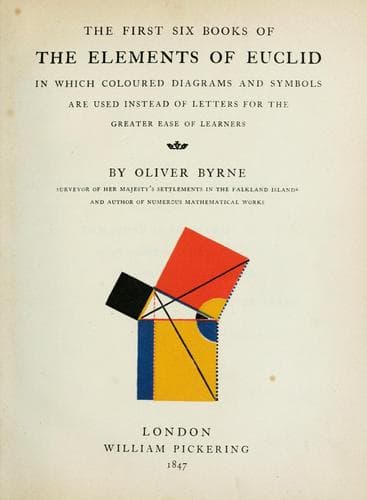
The First Six Books of the Elements of EuclidEuclid
Science
The First Six Books of the Elements of Euclid
Euclid
Euclid's Elements; Mathematics, Greek
Dem.—Since CG is parallel to the side BF of the triangle ABF,
AC : AF :: AG : AB [ii.]; but AC is the fourth part of AF (const.). Hence AG is the
fourth part of AB [V., d.]. In the same manner, any other required submultiple may
be cut off.
Proposition x., Book I., is a particular case of this Proposition.
PROP. X.—Problem.
To divide a given undivided line (AB) similarly to a given divided line (CD).
Sol.—Draw AG, making any angle with AB, and cut off the parts AH, HI, IG
respectively equal to the parts CE, EF, FD of the given divided line CD. Join BG,
and draw HK, IL, each parallel to BG. AB will be divided similarly to
CD.
Dem.—Through H draw HN parallel to AB, cutting IL in M. Now in the
triangle ALI, HK is parallel to IL. Hence [ii.] AK : KL :: AH : HI, that is
:: CE : EF (const.). Again, in the triangle HNG, MI is parallel to NG. Therefore
[ii.] HM : MN :: HI : IG; but [I. xxxiv.] HM is equal to KL, MN is
equal to LB, HI is equal to EF, and IG is equal to FD (const.). Therefore
KL : LB :: EF : FD. Hence the line AB is divided similarly to the line
CD.
Exercises.
1. To divide a given line AB internally or externally in the ratio of two given lines, m,
n.
Sol.—Through A and B draw any two parallels AC and BD in opposite directions. Cut off
AC = m, and BD = n, and join CD; the joining line will divide AB internally at E in the ratio of
m : n.
2. If BD′ be drawn in the same direction with AC, as denoted by the dotted line, then CD′ will
cut AB externally at E′ in the ratio of m : n.
Cor.—The two points E, E′ divide AB harmonically.
This problem is manifestly equivalent to the following:—Given the sum or difference of two lines
and their ratio, to find the lines.
3. Any line AE′, through the middle point B of the base DD′ of a triangle DCD′,
is cut harmonically by the sides of the triangle and a parallel to the base through the
vertex.
4. Given the sum of the squares on two lines and their ratio; find the lines.
5. Given the difference of the squares on two lines and their ratio; find the lines.
6. Given the base and ratio of the sides of a triangle; construct it when any of the following data
is given:—1, the area; 2, the difference on the squares of the sides; 3, the sum of the squares on the
sides; 4, the vertical angle; 5, the difference of the base angles.
PROP. XI.—Problem.
To find a third proportional to two given lines (X, Y ).
Sol.—Draw any two lines AC, AE making an angle. Cut off AB equal X, BC
equal Y , and AD equal Y . Join BD, and draw CE parallel to BD, then DE is the
third proportional required.
Dem.—In the triangle CAE, BD is parallel to CE; therefore AB : BC :: AD : DE
[ii.]; but AB is equal to X, and BC, AD each equal to Y . Therefore X : Y :: Y : DE.
Hence DE is a third proportional to X and Y .
Public-domain text, read in full here on John Shaqi.
Reviews
Reviews
No reviews yet
Be the first to share your thoughts on this work.
Elsewhere in the archive
Join the Discussion
Join the discussion
Sign in to leave a comment or review.
Sign InorCreate an account