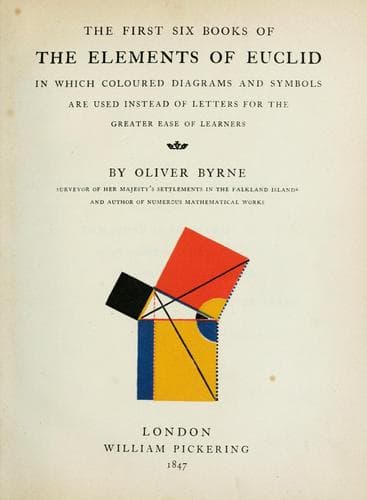
The First Six Books of the Elements of EuclidEuclid
Science
The First Six Books of the Elements of Euclid
Euclid
Euclid's Elements; Mathematics, Greek
If two triangles (ABC, DEF) have one angle (A) one equal to one angle (D) in the
other, the sides about two other angles (B, E) proportional (AB : BC :: DE : EF),
and the remaining angles (C, F) of the same species (i. e. either both acute or both
not acute), the triangles are similar.
Dem.—If the angles B and E are not equal, one must be greater than the other.
Suppose ABC to be the greater, and that the part ABG is equal to DEF, then the
triangles ABG, DEF have two angles in one equal to two angles in the other, and
are [I. xxxii.] equiangular.
Therefore AB : BG :: DE : EF [iv.];
but AB : BC :: DE : EF (hyp.).
Therefore BG is equal to BC. Hence the angles BCG, BGC must be each acute
[I. xvii.]; therefore AGB must be obtuse; hence DFE, which is equal to it, is obtuse;
and it has been proved that ACB is acute; therefore the angles ACB, DFE are of
different species; but (hyp.) they are of the same species, which is absurd. Hence the
angles B and E are not unequal, that is, they are equal. Therefore the triangles are
equiangular.
Cor. 1.—If two triangles ABC, DEF have two sides in one proportional to two
sides in the other, AB : BC :: DE : EF, and the angles A, D opposite one pair of
homologous sides equal, the angles C, F opposite the other are either equal or
supplemental. This Proposition is nearly identical with vii.
Cor. 2.—If either of the angles C, F be right, the other must be right.
PROP. VIII.—Theorem.
The triangles (ACD, BCD) into which a right-angled triangle (ACB) is divided,
by the perpendicular (CD) from the right angle (C) on the hypotenuse, are similar to
the whole and to one another.
Dem.—Since the two triangles ADC, ACB have the angle A common, and the
angles ADC, ACB equal, each being right, they are [I. xxxii.] equiangular; hence
[iv.] they are similar. In like manner it may be proved that BDC is similar to ABC.
Hence ADC, CDB are each similar to ACD, and therefore they are similar to one
another.
Cor. 1.—The perpendicular CD is a mean proportional between the segments
AD, DB of the hypotenuse.
For, since the triangles ADC, CDB are equiangular, we have AD : DC :: DC : DB;
hence DC is a mean proportional between AD, DB (Def. iii.).
Cor. 2.—BC is a mean proportional between AB, BD; and AC between AB,
AD.
Cor. 3.—The segments AD, DB are in the duplicate of AC : CB, or in other
words, AD : DB :: AC2 : CB2,
Cor. 4.—BA : AD in the duplicate ratios of BA : AC; and AB : BD in the
duplicate ratio of AB : BC.
PROP. IX.—Problem.
From a given right line (AB) to cut off any part required (i.e. to cut off any
required submultiple)
.
Sol.—Let it be required, for instance, to cut off the fourth part. Draw AF,
making any angle with AB, and in AF take any point C, and cut off (I. iii.) the
parts CD, DE, EF each equal to AC. Join BF, and draw CG parallel to BF. AG is
the fourth part of AB.
Public-domain text, read in full here on John Shaqi.
Reviews
Reviews
No reviews yet
Be the first to share your thoughts on this work.
Elsewhere in the archive
Join the Discussion
Join the discussion
Sign in to leave a comment or review.
Sign InorCreate an account