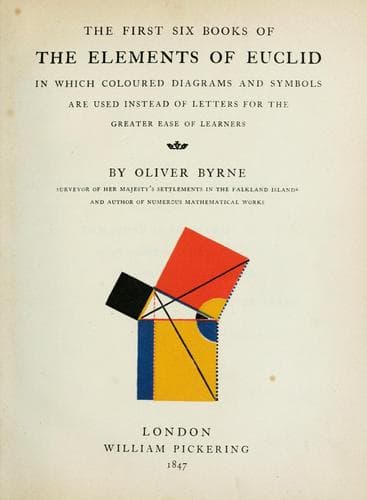
The First Six Books of the Elements of EuclidEuclid
Science
The First Six Books of the Elements of Euclid
Euclid
Euclid's Elements; Mathematics, Greek
Dem.—Let the same construction be made, then we have
AC : CD :: triangle ACB : BCD [i.],
and EC : CB :: triangle DCE : BCD [i.];
but AC : CD :: EC : CB (hyp.).
Therefore the triangle
Hence the triangle ACB = DCE [V. ix.]—that is, the triangles are equal.
This Proposition might have been appended as a Cor. to the preceding, since the triangles are
the halves of equiangular parallelograms, or it may be proved by joining AE, and showing that it is
parallel to BD.
PROP. XVI.—Theorem.
1. If four right lines (AB, CD, E, F) be proportional, the rectangle (AB.F)
contained by the extremes is equal to the rectangle (CD.E) contained by the
means. 2. If the rectangle contained by the extremes of four right lines be equal to the
rectangle contained by the means, the four lines are proportional.
Dem.—1. Erect AH, CI at right angles to AB and CD, and equal to F and E
respectively, and complete the rectangles. Then because AB : CD :: E : F (hyp.), and
that E is equal to CI, and F to AH (const.), we have AB : CD :: CI : AH. Hence
the parallelograms AG, CK are equiangular, and have the sides about their
equal angles reciprocally proportional. Therefore they are [xiv.] equal; but
since AH is equal to F, AG is equal to the rectangle AB.F. In like manner,
CK is equal to the rectangle CD.E. Hence AB.F = CD.E; that is, the
rectangle contained by the extremes is equal to the rectangle contained by the
means.
2. If AB.F = CD.E, to prove AB : CD :: E : F.
The same construction being made, because AB.F = CD.E, and that F is equal
to AH, and E to CI, we have the parallelogram AG = CK; and since these
parallelograms are equiangular, the sides about their equal angles are reciprocally
proportional. Therefore
Or thus: Place the four lines in a concurrent position so that the extremes may form one
continuous line, and the means another. Let the four lines so placed be AO, BO, OD, OC. Join AB,
CD. Then because AO : OB :: OD : OC, and the angle AOB = DOC, the triangles AOB, COD
are equiangular. Hence the four points A, B, C, D are concyclic. Therefore [III. xxxv.]
AO.OC = BO.OD.
PROP. XVII.—Theorem
1. If three right lines (A, B, C) be proportional, the rectangle (A.C) contained by
the extremes is equal to the square (B2) of the mean. 2. If the rectangle contained by the extremes of three right lines be equal to the
square of the mean, the three lines are proportional.
Dem.—1. Assume a line D = B; then because A : B :: B : C, we have
A : B :: D : C. Therefore [xvi.] AC = BD; but BD = B2. Therefore AC = B2;
that is, the rectangle contained by the extremes is equal to the square of the
mean.
2. The same construction being made, since AC = B2, we have A.C = B.D;
therefore A : B :: D : C; but D = B. Hence A : B :: B : C; that is, the three lines are
proportionals.
This Proposition may be inferred as a Cor. to the last, which is one of the fundamental
Propositions in Mathematics.
Exercises.
Public-domain text, read in full here on John Shaqi.
Reviews
Reviews
No reviews yet
Be the first to share your thoughts on this work.
Elsewhere in the archive
Join the Discussion
Join the discussion
Sign in to leave a comment or review.
Sign InorCreate an account