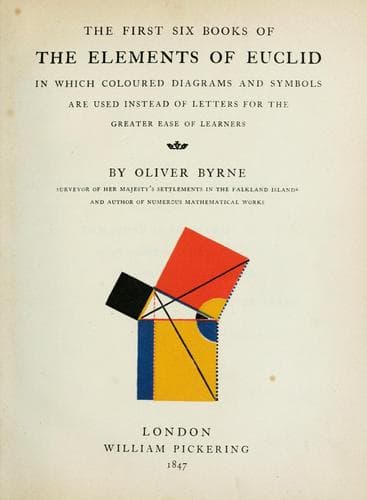
The First Six Books of the Elements of EuclidEuclid
Science
The First Six Books of the Elements of Euclid
Euclid
Euclid's Elements; Mathematics, Greek
1. If a line CD bisect the vertical angle C of any triangle ACB, its square added to the
rectangle AD.DB contained by the segments of the base is equal to the rectangle contained by the
sides.
Dem.—Describe a circle about the triangle, and produce CD to meet it in E; then it is easy to
see that the triangles ACD, ECB are equiangular. Hence [iv.] AC : CD :: CE : CB; therefore
AC.CB = CE.CD = CD2 + CD.DE = CD2 + AD.DB [III. xxxv.].
2. If the line CD′ bisect the external vertical angle of any triangle ACB, its square subtracted
from the rectangle AD′.D′B is equal to AC.CB.
3. The rectangle contained by the diameter of the circumscribed circle, and the radius of the
inscribed circle of any triangle, is equal to the rectangle contained by the segments of any chord of
the circumscribed circle passing through the centre of the inscribed.
Dem.—Let O be the centre of the inscribed circle. Join OB (see foregoing fig.); let fall the
perpendicular OG, draw the diameter EF of the circumscribed circle. Now the angle
ABE = ECB [III. xxvii.], and ABO = OBC; therefore EBO = sum of OCB, OBC = EOB.
Hence EB = EO. Again, the triangles EBF, OGC are equiangular, because EFB, ECB
are equal, and EBF, OGC are each right. Therefore, EF : EB :: OC : OG; therefore
EF.OG = EB.OC = EO.OC.
4. Ex. 3 may be extended to each of the escribed circles of the triangle ACB.
5. The rectangle contained by two sides of a triangle is equal to the rectangle contained by the
perpendicular and the diameter of the circumscribed circle. For, let CE be the diameter. Join AE.
Then the triangles ACE, DCB are equiangular; hence AC : CE :: CD : CB; therefore
AC.CB = CD.CE.
6. If a circle passing through one of the angles A of a parallelogram ABCD intersect
the two sides AB, AD again in the points E, G and the diagonal AC again in F; then
AB.AE + AD.AG = AC.AF.
Dem.—Join EF, FG, and make the angle ABH = AFE. Then the triangles ABH, AFE are
equiangular. Therefore AB : AH :: AF : AE. Hence AB.AE = AF.AH. Again, it is easy to see
that the triangles BCH, FAG are equiangular; therefore BC : CH :: AF : AG; hence
BC.AG = AF.CH, or AD.AG = AF.CH; but we have proved AB.AE = AF.AH. Hence
AD.AG + AB.AE = AF.AC.
7. If DE, DF be parallels to the sides of a triangle ABC from any point D in the base, then
AB.AE + AC.AF = AD2 + BD.DC. This is an easy deduction from 6.
8. If through a point O within a triangle ABC parallels EF, GH, IK to the sides be drawn, the
sum of the rectangles of their segments is equal to the rectangle contained by the segments of any
chord of the circumscribing circle passing through O.
Dem.—AO.AL = AB.AK + AC.AE.
(6)
But
AO2 = AG.AK + AH.AE − GO.OH.
(7)
Hence
AO.OL = BG.AK + CH.AE + GO.OH,
or
AO.OL = EO.OF + IO.OK + GO.OH.
Public-domain text, read in full here on John Shaqi.
Reviews
Reviews
No reviews yet
Be the first to share your thoughts on this work.
Elsewhere in the archive
Join the Discussion
Join the discussion
Sign in to leave a comment or review.
Sign InorCreate an account