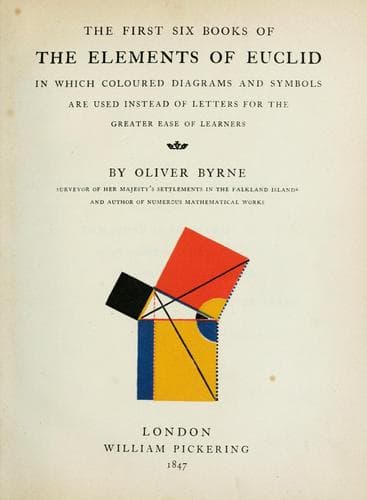
The First Six Books of the Elements of EuclidEuclid
Science
The First Six Books of the Elements of Euclid
Euclid
Euclid's Elements; Mathematics, Greek
Dem.—The same construction being made, since the arc BC is equal to CG, the
angle BOC is equal to COG. Hence the sectors BOC, COG are congruent (see
Observation, Proposition xxix., Book III.); therefore they are equal. In like manner
the sectors COG, GOH are equal. Hence there are as many equal sectors as there are
equal arcs; therefore the arc BH and the sector BOH are equimultiples of the arc
BC and the sector BOC. In the same manner it may be proved that the arc EJ and
the sector EPJ are equimultiples of the arc EF and the sector EPF; and it is
evident, by superposition, that if the arc BH is greater than, equal to, or less
than the arc EJ, the sector BOH is greater than, equal to, or less than the
sector EPJ. Hence [V. Def. v.] the arc BC : EF :: sector BOC : sector
EPF.
The second part may be proved as follows:—
Sector BOC = rectangle contained by the arc BC, and the radius of the circle ABC
[xx. Ex. 14] and sector EPF = rectangle contained by the arc EF and the radius of the circle
EDF; and since the circles are equal, their radii are equal. Hence, sector BOC : sector EPF :: arc
BC : arc EF.
Questions for Examination on Book VI.
1. What is the subject-matter of Book VI.? Ans. Application of the theory of proportion.
2. What are similar rectilineal figures?
3. What do similar figures agree in?
4. How many conditions are necessary to define similar triangles?
5. How many to define similar rectilineal figures of more than three sides?
6. When is a figure said to be given in species?
7. When in magnitude?
8. When in position?
9. What is a mean proportional between two lines?
10. Define two mean proportionals.
11. What is the altitude of a rectilineal figure?
12. If two triangles have equal altitudes, how do their areas vary?
13. How do these areas vary if they have equal bases but unequal altitudes?
14. If both bases and altitudes differ, how do the areas vary?
15. When are two lines divided proportionally?
16. If in two lines divided proportionally a pair of homologous points coincide with their point
of intersection, what property holds for the lines joining the other pairs of homologous
points?
17. Define reciprocal proportion.
18. If two triangles have equal areas, prove that their perpendiculars are reciprocally
proportional to the bases.
19. What is meant by figures inversely similar?
20. If two figures be inversely similar, how can they be changed into figures directly
similar?
21. Give an example of two triangles inversely similar. Ans. If two lines passing through any
point O outside a circle intersect it in pairs of points A, A′; B, B′, respectively, the triangles OAB,
OA′B′, are inversely similar.
22. What point is it round which a figure can be turned so as to bring its sides into positions of
parallelism with the sides of a similar rectilineal figure. Ans. The centre of similitude of the two
figures.
Public-domain text, read in full here on John Shaqi.
Reviews
Reviews
No reviews yet
Be the first to share your thoughts on this work.
Elsewhere in the archive
Join the Discussion
Join the discussion
Sign in to leave a comment or review.
Sign InorCreate an account