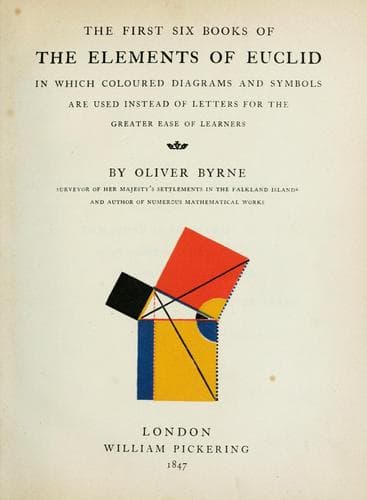
The First Six Books of the Elements of EuclidEuclid
Science
The First Six Books of the Elements of Euclid
Euclid
Euclid's Elements; Mathematics, Greek
If semicircles be described on supplemental chords of a semicircle, the sum of the areas of the
two crescents thus formed is equal to the area of the triangle whose sides are the supplemental
chords and the diameter.
PROP. XXXII.—Theorem.
If two triangles (ABC, CDE) which have two sides of one proportional to two sides
of the other (AB : BC :: CD : DE), and the contained angles (B, D) equal, be
joined at an angle (C), so as to have their homologous sides parallel, the remaining
sides are in the same right line.
Dem.—Because the triangles ABC, CDE have the angles B and D equal, and
the sides about these angles proportional, viz., AB : BC :: CD : DE, they are
equiangular [vi.]; therefore the angle BAC is equal to DCE. To each add ACD, and
we have the sum of the angles BAC, ACD equal to the sum of DCE and ACD; but
the sum of BAC, ACD is [I. xxix.] two right angles; therefore the sum of DCE and
ACD is two right angles. Hence [I. xiv.] AC, CE are in the same right
line.
PROP. XXXIII.–Theorem.
In equal circles, angles (BOC, EPF) at the centres or (BAC, EDF) at the
circumferences have the same ratio to one another as the arcs (BC, EF) on which
they stand, and so also have the sectors (BOC, EPF).
Dem.—1. Take any number of arcs CG, GH in the first circle, each equal to BC.
Join OG, OH, and in the second circle take any number of arcs FI, IJ, each equal to
EF. Join IP, JP. Then because the arcs BC, CG, GH are all equal, the angles
BOC, COG, GOH, are all equal [III. xxvii.]. Therefore the arc BH and the angle
BOH are equimultiples of the arc BC and the angle BOC. In like manner it may be
proved that the arc EJ and the angle EPJ are equimultiples of the arc EF and the
angle EPF. Again, since the circles are equal, it is evident that the angle BOH is
greater than, equal to, or less than the angle EPJ, according as the arc
BH is greater than, equal to, or less than the arc EJ. Now we have four
magnitudes, namely, the arc BC, the arc EF, the angle BOC, and the angle
EPF; and we have taken equimultiples of the first and third, namely, the arc
BH, the angle BOH, and other equimultiples of the second and fourth,
namely, the arc EJ and the angle EPJ, and we have proved that, according as
the multiple of the first is greater than, equal to, or less than the multiple
of the second, the multiple of the third is greater than, equal to, or less
than the multiple of the fourth. Hence [V. Def. v.] BC : EF :: the angle
BOC : EPF.
Again, since the angle BAC is half the angle BOC [III. xx.], and EDF is half
the angle EPF,
BAC : EDF :: BOC : EPF [V. xv.];
but BOC : EPF :: BC : EF.
Hence BAC : EDF :: BC : EF [V. xi.].
2. The sector BOC : sector EPF :: BC : EF.
Public-domain text, read in full here on John Shaqi.
Reviews
Reviews
No reviews yet
Be the first to share your thoughts on this work.
Elsewhere in the archive
Join the Discussion
Join the discussion
Sign in to leave a comment or review.
Sign InorCreate an account