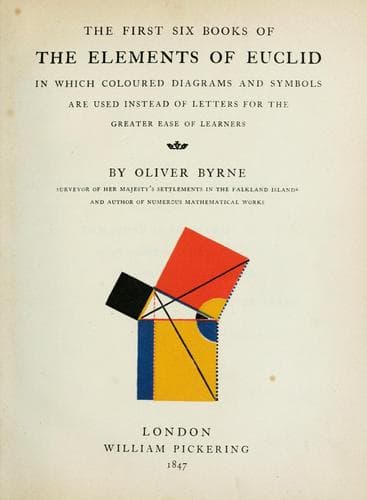
The First Six Books of the Elements of EuclidEuclid
Science
The First Six Books of the Elements of Euclid
Euclid
Euclid's Elements; Mathematics, Greek
Dem.—Join AD. Describe a circle about the triangle ADI, cutting the lines AF, CD produced,
if necessary, in K and L. Join IK, KL, LI. Now, the angles KLG, FCG are each [III. xxi.] equal to
the angle GAD. Hence they are equal. Therefore KL is parallel to CF. Similarly, LI is
parallel to CH, and KI to FH; hence the triangles KLI, FCH are homothetic. Hence the
lines joining corresponding vertices are concurrent. Therefore the points I, H, G are
collinear.
73. If two sides of a triangle circumscribed to a given circle be given in position, but the third
side variable, the circle described about the triangle touches a fixed circle.
74. If two sides of a triangle be given in position, and if the area be given in magnitude, two
points can be found, at each of which the base subtends a constant angle.
75. If a, b, c, d denote the sides of a cyclic quadrilateral, and s its semiperimeter, prove its area
= .
76. If three concurrent lines from the angles of a triangle ABC meet the opposite side in
the points A′, B′, C′, and the points A′, B′, C′ be joined, forming a second triangle
A′B′C′,
77. In the same case the diameter of the circle circumscribed about the triangle
ABC = AB′.BC′.CA′ divided by the area of A′B′C′.
78. If a quadrilateral be inscribed in one circle, and circumscribed to another, the square of its
area is equal to the product of its four sides.
79. If on the sides AB, AC of a triangle ABC we take two points D, E, and on their line of
connexion F, such that
prove the triangle BFC = 2ADE.
80. If through the middle points of each of the two diagonals of a quadrilateral we draw a
parallel to the other, the lines drawn from their points of intersection to the middle points of the
sides divide the quadrilateral into four equal parts.
81. CE, DF are perpendiculars to the diameter of a semicircle, and two circles are described
touching CE, DE, and the semicircle, one internally and the other externally; the rectangle
contained by the perpendiculars from their centres on AB is equal to CE.DF.
82. If lines be drawn from any point in the circumference of a circle to the angular points of any
inscribed regular polygon of an odd number of sides, the sums of the alternate lines are
equal.
83. If at the extremities of a chord drawn through a given point within a given circle tangents
be drawn, the sum of the reciprocals of the perpendiculars from the point upon the tangents is
constant.
84. If a cyclic quadrilateral be such that three of its sides pass through three fixed collinear
points, the fourth side passes through a fourth fixed point, collinear with the three given
ones.
85. If all the sides of a polygon be parallel to given lines, and if the loci of all the angles but one
be right lines, the locus of the remaining angle is also a right line.
86. If the vertical angle and the bisector of the vertical angle be given, the sum of the
reciprocals of the containing sides is constant.
Public-domain text, read in full here on John Shaqi.
Reviews
Reviews
No reviews yet
Be the first to share your thoughts on this work.
Elsewhere in the archive
Join the Discussion
Join the discussion
Sign in to leave a comment or review.
Sign InorCreate an account