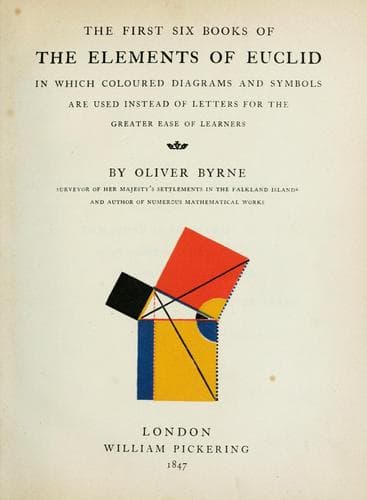
The First Six Books of the Elements of EuclidEuclid
Science
The First Six Books of the Elements of Euclid
Euclid
Euclid's Elements; Mathematics, Greek
87. If P, P′ denote the areas of two regular polygons of any common number of sides, inscribed
and circumscribed to a circle, and Π, Π′ the areas of the corresponding polygons of double the
number of sides; prove Π is a geometric mean between P and P′, and Π′ a harmonic mean between
Π and P′.
88. The difference of the areas of the triangles formed by joining the centres of the circles
described about the equilateral triangles constructed—(1) outwards; (2) inwards—on the sides of
any triangle, is equal to the area of that triangle.
89. In the same case, the sum of the squares of the sides of the two new triangles is equal to the
sum of the squares of the sides of the original triangle.
90. If R, r denote the radii of the circumscribed and inscribed circles to a regular polygon of any
number of sides, R′, r′, corresponding radii to a regular polygon of the same area, and double the
number of sides; prove
91. If the altitude of a triangle be equal to its base, the sum of the distances of the
orthocentre from the base and from the middle point of the base is equal to half the
base.
92. In any triangle, the radius of the circumscribed circle is to the radius of the circle which is
the locus of the vertex, when the base and the ratio of the sides are given, as the difference of the
squares of the sides is to four times the area.
93. Given the area of a parallelogram, one of its angles, and the difference between its diagonals;
construct the parallelogram.
94. If a variable circle touch two equal circles, one internally and the other externally, and
perpendiculars be let fall from its centre on the transverse tangents to these circles, the rectangle of
the intercepts between the feet of these perpendiculars and the intersection of the tangents is
constant.
95. Given the base of a triangle, the vertical angle, and the point in the base whose distance
from the vertex is equal half the sum of the sides; construct the triangle.
96. If the middle point of the base BC of an isosceles triangle ABC be the centre of a circle
touching the equal sides, prove that any variable tangent to the circle will cut the sides in points D,
E, such that the rectangle BD.CE will be constant.
97. Inscribe in a given circle a trapezium, the sum of whose opposite parallel sides is given, and
whose area is given.
98. Inscribe in a given circle a polygon all whose sides pass through given points.
99. If two circles X, Y be so related that a triangle may be inscribed in X and circumscribed
about Y , an infinite number of such triangles can be constructed.
100. In the same case, the circle inscribed in the triangle formed by joining the points of contact
on Y touches a given circle.
101. And the circle described about the triangle formed by drawing tangents to X, at the
angular points of the inscribed triangle, touches a given circle.
Public-domain text, read in full here on John Shaqi.
Reviews
Reviews
No reviews yet
Be the first to share your thoughts on this work.
Elsewhere in the archive
Join the Discussion
Join the discussion
Sign in to leave a comment or review.
Sign InorCreate an account