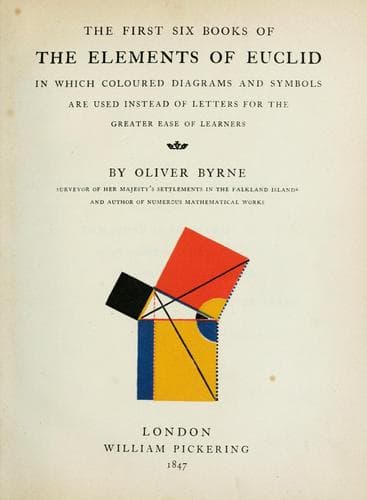
The First Six Books of the Elements of EuclidEuclid
Science
The First Six Books of the Elements of Euclid
Euclid
Euclid's Elements; Mathematics, Greek
121. Construct a polygon of an odd number of sides, being given that the sides taken in order
are divided in given ratios by fixed points.
122. If the external diagonal of a quadrilateral inscribed in a given circle be a chord of another
given circle, the locus of its middle point is a circle.
123. If a chord of one circle be a tangent to another, the line connecting the middle point of
each arc which it cuts off on the first, to its point of contact with the second, passes through a given
point.
124. From a point P in the plane of a given polygon perpendiculars are let fall on its sides; if
the area of the polygon formed by joining the feet of the perpendiculars be given, the locus of P is a
circle.
BOOK XI.
THEORY OF PLANES, COPLANAR LINES, AND SOLID
ANGLES
_______
DEFINITIONS.
i. When two or more lines are in one plane they are said to be coplanar.
ii. The angle which one plane makes with another is called a dihedral
angle.
iii. A solid angle is that which is made by more than two plane angles, in different
planes, meeting in a point.
iv. The point is called the vertex of the solid angle.
v. If a solid angle be composed of three plane angles it is called a trihedral
angle; if of four, a tetrahedral angle; and if of more than four, a polyhedral
angle.
PROP. I.—Theorem.
One part (AB) of a right line cannot be in a plane (X), and another part
(BC) not in it.
Dem.—Since AB is in the plane X, it can be produced in it [Bk. I. Post. ii.]; let
it be produced to D. Then, if BC be not in X, let any other plane passing through
AD be turned round AD until it passes through the point C. Now, because the
points B, C are in this second plane, the line BC [I., Def. vi.] is in it. Therefore the
two right lines ABC, ABD lying in one plane have a common segment AB, which is
impossible. Therefore, &c.
PROP. II.—Theorem.
Two right lines (AB, CD) which intersect one another in any point (E) are
coplanar, and so also are any three right lines (EC, CB, BE) which form a
triangle.
Dem.—Let any plane pass through EB, and be turned round it until it passes
through C. Then because the points E, C are in this plane, the right line EC is in it
[I., Def. vi.]. For the same reason the line BC is in it. Therefore the lines EC, CB,
BE are coplanar; but AB and CD are two of these lines. Hence AB and CD are
coplanar.
PROP. III.—Theorem.
If two planes (AB, BC) cut one another, their common section (BD) is a
right line.
Dem.—If not from B to D, draw in the plane AB the right line BED, and in the
plane BC the right line BFD. Then the right lines BED, BFD enclose a space,
which [I., Axiom x.] is impossible. Therefore the common section BD of the two
planes must be a right line.
PROP. IV.—Theorem.
If a right line (EF) be perpendicular to each of two intersecting lines (AB, CD), it
will be perpendicular to any line GH, which is both coplanar and concurrent with
them.
Public-domain text, read in full here on John Shaqi.
Reviews
Reviews
No reviews yet
Be the first to share your thoughts on this work.
Elsewhere in the archive
Join the Discussion
Join the discussion
Sign in to leave a comment or review.
Sign InorCreate an account