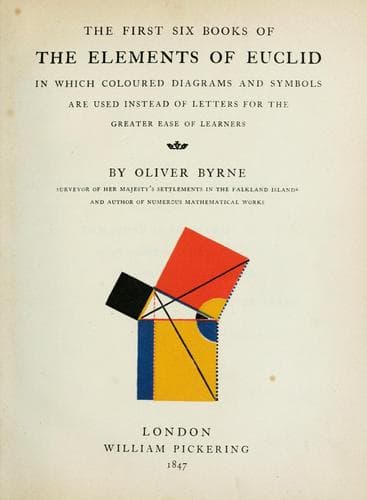
The First Six Books of the Elements of EuclidEuclid
Science
The First Six Books of the Elements of Euclid
Euclid
Euclid's Elements; Mathematics, Greek
Dem.—Through any point G in GH draw a line BC intersecting AB, CD, and
so as to be bisected in G; and join any point F in EF to B, G, C. Then, because EF
is perpendicular to the lines EB, EC, we have
BF2 = BE2 + EF2, and CF2 = CE2 + EF2;
∴ BF2 + CF2
= BE2 + CE2 + 2EF2.
Again
BF2 + CF2
= 2BG2 + 2GF2 [II. x. Ex. 2],
and
BE2 + CE2
= 2BG2 + 2GE2;
∴ 2BG2 + 2GF2
= 2BG2 + 2GE2 + 2EF2;
∴ GF2
= GE2 + EF2.
Hence the angle GEF is right, and EF is perpendicular to EG.
Def. vi.—A line such as EF, which is perpendicular to a system of concurrent
and coplanar lines, is said to be perpendicular to the plane of these lines, and is called
a normal to it.
Cor. 1.—The normal is the least line that may be drawn from a given point to a
given plane; and of all others that may be drawn to it, the lines of any system
making equal angles with the normal are equal to each other.
Cor. 2.—A perpendicular to each of two intersecting lines is normal to their
plane.
PROP. V.—Theorem.
If three concurrent lines (BC, BD, BE) have a common perpendicular (AB),
they are coplanar.
Dem.—For if possible let BC be not coplanar with BD, BE, and let the plane of
AB, BC intersect the plane of BD, BE in the line BF. Then [XI. iii.] BF is a right
line; and, since it is coplanar with BD, BE, which are each perpendicular
to AB, it is [XI. iv.] perpendicular to AB. Therefore the angle ABF is
right; and the angle ABC is right (hyp.). Hence ABC is equal to ABF,
which is impossible [I., Axiom ix.]. Therefore the lines BC, BD, BE are
coplanar.
PROP. VI.—Theorem.
If two right lines (AB, CD) be normals to the same plane (X), they shall be
parallel to one another.
Dem.—Let AB, CD meet the plane X at the points B, D. Join BD, and in the
plane X draw DE at right angles to BD; take any point E in DE. Join BE, AE,
AD. Then because AB is normal to X, the angle ABE is right. Therefore
AE2 = AB2 + BE2 = AB2 + BD2 + DE2; because the angle BDE is right. But
AB2 + BD2 = AD2, because the angle ABD is right. Hence AE2 = AD2 + DE2.
Therefore the angle ADE is right. [I. xlviii]. And since CD is normal to the plane
X, DE is perpendicular to CD. Hence DE is a common perpendicular to the three
concurrent lines CD, AD, BD. Therefore these lines are coplanar [XI. v.]. But AB is
coplanar with AD, BD [XI. ii.]. Therefore the lines AD, BD, CD are coplanar;
and since the angles ABD, BDC are right, the line AB is parallel to CD
[I. xxviii.].
Def. vii.—If from every point in a given line normals be drawn to a given
plane, the locus of their feet is called the projection of the given line on the
plane.
Exercises.
1. The projection of any line on a plane is a right line.
2. The projection on either of two intersecting planes of a normal to the other plane is
perpendicular to the line of intersection of the planes.
PROP. VII.—Theorem.
Two parallel lines (AB, CD) and any line (EF) intersecting them are
coplanar.
Public-domain text, read in full here on John Shaqi.
Reviews
Reviews
No reviews yet
Be the first to share your thoughts on this work.
Elsewhere in the archive
Join the Discussion
Join the discussion
Sign in to leave a comment or review.
Sign InorCreate an account