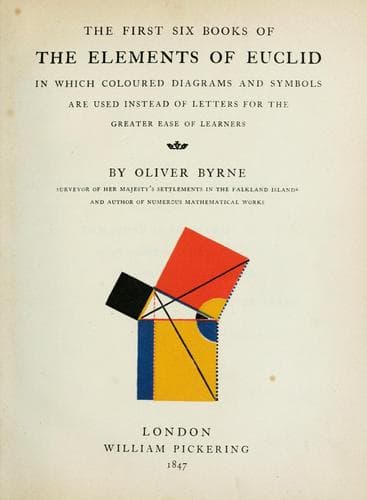
The First Six Books of the Elements of EuclidEuclid
Science
The First Six Books of the Elements of Euclid
Euclid
Euclid's Elements; Mathematics, Greek
Dem.—If possible let the intersecting line be out of the plane, as EGF. And
in the plane, of the parallels draw [I. Post. ii.] the right line EHF. Then
we have two right lines EGF, EHF, enclosing a space, which [I. Axiom
x.] is impossible. Hence the two parallel right lines and the transversal are
coplanar.
Or thus: Since the points E, F are in the plane of the parallels, the line joining these points is in
that plane [I. Def. vi].
PROP. VIII.—Theorem.
If one (AB) of two parallel right lines (AB, CD), be normal to a plane (X),
the other line (CD) shall be normal to the same plane.
Dem.—Let AB, CD meet the plane X in the points B, D. Join BD. Then the
lines AB, BD, CD are coplanar. Now in the plane X, to which AB is normal, draw
DE at right angles to BD. Take any point E in DE, and join BE, AE,
AD.
Then because AB is normal to the plane X, it is perpendicular to the line
BE in that plane [XI. Def. vi.]. Hence the angle ABE is right; therefore
AE2 = AB2 + BE2 = AB2 + BD2 + DE2 (because BDE is right (const.))
= AD2 + DE2 (because ABD is right (hyp.)). Therefore the angle ADE is right.
Hence DE is at right angles both to AD and BD. Therefore [XI. iv.] DE is
perpendicular to CD, which is coplanar and concurrent with AD and BD. Again,
since AB and CD are parallel, the sum of the angles ABD, BDC is two right angles
[I. xxix.]; but ABD is right (hyp.); therefore BDC is right. Hence CD is
perpendicular to the two lines DB, DE, and therefore [XI. iv.] it is normal to their
plane, that is, it is normal to X.
PROP. IX—Theorem.
Two right lines (AB, CD) which are each parallel to a third line (EF) are
parallel to one another.
Dem.—If the three lines be coplanar, the Proposition is evidently the same as
I. xxx. If they are not coplanar, from any point G in EF draw in the planes of
EF, AB; EF, CD, respectively, the lines GH, GK each perpendicular to
EF [I. xi.]. Then because EF is perpendicular to each of the lines GH,
GK, it is normal to their plane [XI. iv.]. And because AB is parallel to EF
(hyp.), and EF is normal to the plane GHK, AB is normal to the plane
GHK [XI. viii.]. In like manner CD is normal to the plane HGK. Hence,
since AB and CD are normals to the same plane, they are parallel to one
another.
PROP. X.—Theorem.
If two intersecting right lines (AB, BC) be respectively parallel to two other
intersecting right lines (DE, EF), the angle (ABC) between the former is equal to
the angle (DEF) between the latter.
Public-domain text, read in full here on John Shaqi.
Reviews
Reviews
No reviews yet
Be the first to share your thoughts on this work.
Elsewhere in the archive
Join the Discussion
Join the discussion
Sign in to leave a comment or review.
Sign InorCreate an account