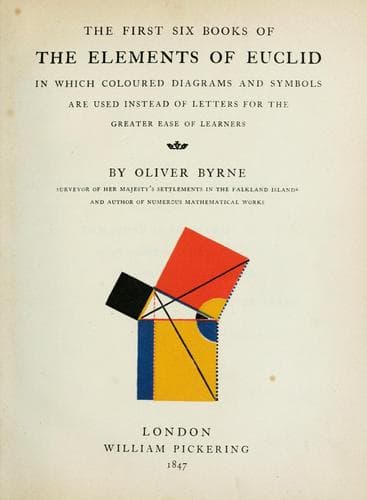
The First Six Books of the Elements of EuclidEuclid
Science
The First Six Books of the Elements of Euclid
Euclid
Euclid's Elements; Mathematics, Greek
Then the triangles BAD, BAE have the two sides BA, AD in one equal
respectively to the two sides BA, AE in the other, and the angle BAD equal to
BAE; therefore the third side BD is equal to BE. But the sum of the sides BD, DC
is greater than BC; hence DC is greater than EC. Again, because the triangles
DAC, EAC have the sides DA, AC respectively equal to the sides EA,
AC in the other, but the base DC greater than EC; therefore [I. xxv.]
the angle DAC is greater than EAC, but the angle DAB is equal to BAE
(const.). Hence the sum of the angles BAD, DAC is greater than the angle
BAC.
PROP. XXI.—Theorem.
The sum of all the plane angles (BAC, CAD, &c.) forming any solid angle (A) is
less than four right angles.
Dem.—Suppose for simplicity that the solid angle A is contained by five plane
angles BAC, CAD, DAE, EAF, FAB; and let the planes of these angles be cut by
another plane in the lines BC, CD, DE, EF, FB; then we have [XI. xx.],
∠ABC + ABF greater than FBC,
∠ACB + ACD ,, BCD, &c.
Hence, adding, we get the sum of the base angles of the five triangles BAC, CAD, &c.,
greater than the sum of the interior angles of the pentagon BCDEF —that is,
greater than six right angles. But the sum of the base angles of the same triangles,
together with the sum of the plane angles BAC, CAD, &c., forming the solid angle
A, is equal to twice as many right angles as there are triangles BAC, CAD,
&c.—that is, equal to ten right angles. Hence the sum of the angles forming the solid
angle is less than four right angles.
Observation.—This Prop. may not hold if the polygonal base BCDEF contain re-entrant
angles.
Exercises on Book XI.
1. Any face angle of a trihedral angle is less than the sum, but greater than the difference, of the
supplements of the other two face angles.
2. A solid angle cannot be formed of equal plane angles which are equal to the angles of a
regular polygon of n sides, except in the case of n = 3, 4, or 5.
3. Through one of two non-coplanar lines draw a plane parallel to the other.
4. Draw a common perpendicular to two non-coplanar lines, and show that it is the shortest
distance between them.
5. If two of the plane angles of a tetrahedral angle be equal, the planes of these angles are
equally inclined to the plane of the third angle, and conversely. If two of the planes of a trihedral
angle be equally inclined to the third plane, the angles contained in those planes are
equal.
6. The three lines of intersection of three planes are either parallel or concurrent.
7. If a trihedral angle O be formed by three right angles, and A, B, C be points along the
edges, the orthocentre of the triangle ABC is the foot of the normal from O on the plane
ABC.
Public-domain text, read in full here on John Shaqi.
Reviews
Reviews
No reviews yet
Be the first to share your thoughts on this work.
Elsewhere in the archive
Join the Discussion
Join the discussion
Sign in to leave a comment or review.
Sign InorCreate an account