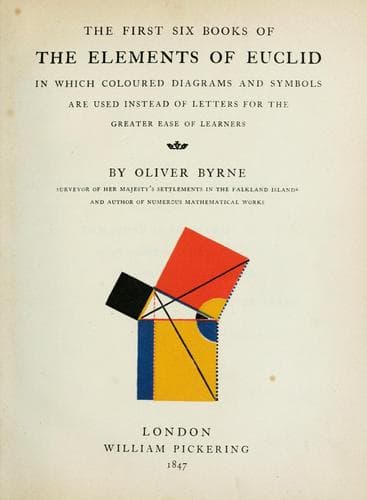
The First Six Books of the Elements of EuclidEuclid
Science
The First Six Books of the Elements of Euclid
Euclid
Euclid's Elements; Mathematics, Greek
8. If through the vertex O of a trihedral angle O—ABC any line OD be drawn interior to the
angle, the sum of the rectilineal angles DOA, DOB, DOC is less than the sum, but greater than
half the sum, of the face angles of the trihedral.
9. If on the edges of a trihedral angle O—ABC three equal lines OA, OB, OC be
taken, each of these is greater than the radius of the circle described about the triangle
ABC.
10. Given the three angles of a trihedral angle, find, by a plane construction, the angles between
the containing planes.
11. If any plane P cut the four sides of a Gauche quadrilateral (a quadrilateral whose angular
points are not coplanar) ABCD in four points, a, b, c, d, then the product of the four
ratios
is plus unity, and conversely, if the product
the points a, b, c, d are coplanar.
12. If in the last exercise the intersecting plane be parallel to any two sides of the quadrilateral,
it cuts the two remaining sides proportionally.
Def. x.—If at the vertex O of a trihedral angle O—ABC we draw normals OA′, OB′, OC′ to
the faces OBC, OCA, OAB, respectively, in such a manner that OA′ will be on the same side of the
plane OBC as OA, &c., the trihedral angle O—A′B′C′ is called the supplementary of the trihedral
angle O—ABC.
13. If O—A′B′C′ be the supplementary of O—ABC, prove that O—ABC is the supplementary
of O—A′B′C′.
14. If two trihedral angles be supplementary, each dihedral angle of one is the supplement of the
corresponding face angle of the other.
15. Through a given point draw a right line which will meet two non-coplanar lines.
16. Draw a right line parallel to a given line, which will meet two non-coplanar lines.
17. Being given an angle AOB, the locus of all the points P of space, such that the sum of the
projections of the line OP on OA and OB may be constant, is a plane.
APPENDIX.
PRISM, PYRAMID, CYLINDER, SPHERE, AND CONE
________________
DEFINITIONS.
i. A polyhedron is a solid figure contained by plane figures: if it be contained by
four plane figures it is called a tetrahedron; by six, a hexahedron; by eight, an
octahedron; by twelve, a dodecahedron; and if by twenty, an icosahedron.
ii. If the plane faces of a polyhedron be equal and similar rectilineal figures, it is
called a regular polyhedron.
iii. A pyramid is a polyhedron of which all the faces but one meet in a point. This
point is called the vertex; and the opposite face, the base.
iv. A prism is a polyhedron having a pair of parallel faces which are equal and
similar rectilineal figures, and are called its ends. The others, called its side faces, are
parallelograms.
v. A prism whose ends are perpendicular to its sides is called a right prism; any
other is called an oblique prism.
vi. The altitude of a pyramid is the length of the perpendicular drawn from its
vertex to its base; and the altitude of a prism is the perpendicular distance between
its ends.
Public-domain text, read in full here on John Shaqi.
Reviews
Reviews
No reviews yet
Be the first to share your thoughts on this work.
Elsewhere in the archive
Join the Discussion
Join the discussion
Sign in to leave a comment or review.
Sign InorCreate an account