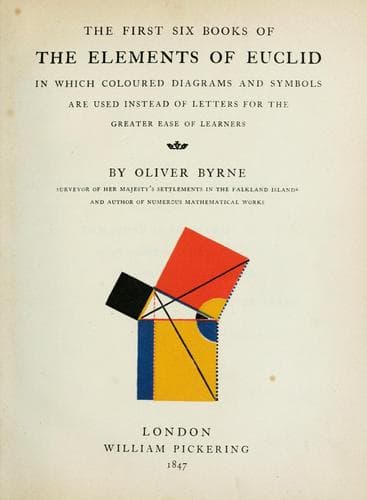
The First Six Books of the Elements of EuclidEuclid
Science
The First Six Books of the Elements of Euclid
Euclid
Euclid's Elements; Mathematics, Greek
1∘. Let the edges MN, EF be in one right line; then GH, OP must be in one
right line. Now EF = MN, because each equal AB; therefore ME = NF; therefore
the prisms AEM–DHP, and BFN–CGO, have their triangular bases AEM, BFN
identically equal, and they have equal altitudes; hence they are equal; and supposing
them taken away from the entire solid, the remaining parallelopipeds ABCD–EFGH,
ABCD–MNOP are equal.
2∘. Let the edges EF, MN be in different lines; then produce ON, PM to
meet the lines EF and GH produced in the points J, K, L, I. Then by 1∘
the parallelopipeds ABCD–EFGH, ABCD–MNOP are each equal to the
parallelopiped ABCD–IJKL. Hence they an equal to one another.
Cor.—The volume of any parallelopiped is equal to the product of its base and
altitude.
PROP. III.—Theorem.
A diagonal plane of a parallelopiped divides it into two prisms of equal volume.
1∘. When the parallelopiped is rectangular the proposition is evident.
2∘. When it is any parallelopiped, ABCD–EFGH, the diagonal plane bisects
it.
Dem.—Through the vertices A, E let planes be drawn perpendicular to the edges
and cutting them in the points I, J, K; L, M, N, respectively. Then [I. xxxiv.] we
have IL = BF, because each is equal to AE. Hence IB = LF. In like manner
JC = MG. Hence the pyramid A–IJCB agrees in everything but position with
E–LMGF; hence it is equal to it in volume. To each add the solid ABC–LME, and
we have the prism AIJ–ELM equal to the prism ABC–EFG. In like manner
AJK–EMN = ACD–EGH; but (1∘) the prism AIJ–ELM = AJK–EMN.
Hence ABC–EFG = ACD–EGH. Therefore the diagonal plane bisects the
parallelopiped.
Cor. 1.—The volume of a triangular prism is equal to the product of its base and
altitude; because it is half of a parallelopiped, which has a double base and equal
altitude.
Cor. 2.—The volume of any prism is equal to the product of its base and
altitude; because it can be divided into triangular prisms.
PROP. IV.—Theorem.
If a pyramid (O–ABCDE) be cut by any plane (abcde) parallel to the base, the
section is similar to the base.
Dem.—Because the plane AOB cuts the parallel planes ABCDE, abcde, the
sections AB, ab are parallel [XI. xvi.] In like manner BC, bc are parallel. Hence the
angle ABC = abc [XI. x.]. In like manner the remaining angles of the polygon
ABCDE are equal to the corresponding angles of abcde. Again, because ab is parallel
to AB, the triangles ABO, abO are equiangular.
Hence AB : BO :: ab : bO. [VI. iv.]
In like manner BO : BC :: bO : bc;
therefore AB : BC :: ab : bc. [Ex æquali.]
In like manner BC : CD :: bc : cd, &c.
Therefore the polygons ABCDE, abcde are equiangular, and have the sides about
their equal angles proportional. Hence they are similar.
Cor. 1.—The edges and the altitude of the pyramid are similarly divided by the
parallel plane.
Cor. 2.—The areas of parallel sections are in the duplicate ratio of the distances
of their planes from the vertex.
Public-domain text, read in full here on John Shaqi.
Reviews
Reviews
No reviews yet
Be the first to share your thoughts on this work.
Elsewhere in the archive
Join the Discussion
Join the discussion
Sign in to leave a comment or review.
Sign InorCreate an account