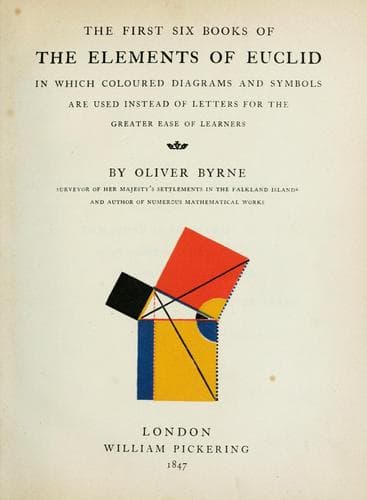
The First Six Books of the Elements of EuclidEuclid
Science
The First Six Books of the Elements of Euclid
Euclid
Euclid's Elements; Mathematics, Greek
vii. A parallelopiped is a prism whose bases are parallelograms. A parallelopiped
is evidently a hexahedron.
viii. A cube is a rectangular parallelopiped, all whose sides are squares.
ix. A cylinder is a solid figure formed by the revolution of a rectangle about one
of its sides, which remains fixed, and which is called its axis. The circles which
terminate a cylinder are called its bases or ends.
x. A cone is the solid figure described by the revolution of a right-angled triangle
about one of the legs, which remains fixed, and which is called the axis. The other leg
describes the base, which is a circle.
xi. A sphere is the solid described by the revolution of a semicircle about a
diameter, which remains fixed. The centre of the sphere is the centre of the
generating semicircle. Any line passing through the centre of a sphere and terminated
both ways by the surface is called a diameter.
PROP. I.—Theorem.
Right prisms (ABCDE–FGHIJ, A′B′C′D′E′–F′G′H′I′J′) which have bases
(ABCDE, A′B′C′D′E′) that are equal and similar, and which have equal altitudes,
are equal.
Dem.—Apply the bases to each other; then, since they are equal and similar
figures, they will coincide—that is, the point A with A′, B with B′, &c. And since
AF is equal to A′F′, and each is normal to its respective base, the: point F will
coincide with F′. In the same manner the points G, H, I, J will coincide
respectively with the points G′, H′, I′, J′. Hence the prisms are equal in every
respect.
Cor. 1.—Right prisms which have equal bases (EF, E′F′) and equal altitudes are
equal in volume.
Dem.—Since the bases are equal, but not similar, we can suppose one of them,
EF, divided into parts A, B, C, and re-arranged so as to make them coincide with
the other [I. xxxv., note]; and since the prism on E′F′ can be subdivided in
the same manner by planes perpendicular to the base, the proposition is
evident.
Cor. 2.—The volumes of right prisms (X, Y ) having equal bases are proportional
to their altitudes.
For, if the altitudes be in the ratio of m : n, X can be divided into m prisms
of equal altitudes by planes parallel to the base; then these m prisms will
be all equal. In like manner, Y can be divided into n equal prisms. Hence
X : Y :: m : n.
Cor. 3.—In right prisms of equal altitudes the volumes are to one another as the
areas of their bases. This may be proved by dividing the bases into parts so that the
subdivisions will be equal, and then the volumes proportional to the number of
subdivisions in their respective bases, that is, to their areas.
Cor. 4.—The volume of a rectangular parallelopiped is measured by the
continued product of its three dimensions.
PROP. II.—Theorem.
Parallelopipeds (ABCD–EFGH, ABCD–MNOP), having a common base
(ABCD) and equal altitudes, are equal.
Public-domain text, read in full here on John Shaqi.
Reviews
Reviews
No reviews yet
Be the first to share your thoughts on this work.
Elsewhere in the archive
Join the Discussion
Join the discussion
Sign in to leave a comment or review.
Sign InorCreate an account