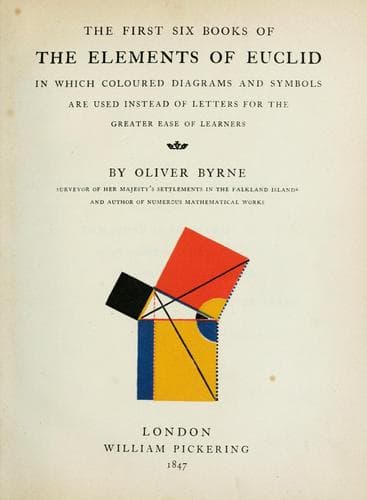
The First Six Books of the Elements of EuclidEuclid
Science
The First Six Books of the Elements of Euclid
Euclid
Euclid's Elements; Mathematics, Greek
perpendicular to the base, and cutting it in the lines OA, OB, will be faces of a
triangular prism, whose base will be the triangle AOB, and whose altitude will be
the altitude of the cylinder. The volume of this prism will be equal to the area of the
triangle AOB by the height of the cylinder. Hence, dividing the circle into
elementary triangles, the cylinder will be equal to the sum of all the prisms, and
therefore its volume will be equal to the area of the base multiplied by the
altitude.
Cor. 1.—If r be the radius, and h the height of the cylinder,
Cor. 2.—If ABCD be a rectangle; X a line in its plane parallel to the side AB; O
the middle point of the rectangle; the volume of the solid described by the revolution
of ABCD round X is equal to the area of ABCD multiplied by the circumference of
the circle described by O.
Dem.—Produce the lines AD, BC to meet X in the points E, F. Then when the
rectangle revolves round X, the rectangles ABFE, DCFE will describe cylinders
whose bases will be circles having AE, DE as radii, and whose common altitude
will be AB. Hence the difference between the volumes of these cylinders
will be equal to the differences between the areas of the bases multiplied
by AB, that is = π(AE2 − DE2).AB. Therefore the volume described by
ABCD
= π.AB.(AE + DE)(AE − DE);
but AE + DE = 2OG, and AE − DE = AD.
Hence volume described by the rectangle ABCD
= 2π.OG.AB.AD.
= rectangle ABCD multiplied by the circumference of
the circle described by its middle point O.
Observation.—This Cor. is a simple case of Guldinus’s celebrated theorem. By its assistance we
give in the two following corollaries original methods of finding the volumes of the cone and sphere,
and it may be applied with equal facility to the solution of several other problems which are usually
done by the Integral Calculus.
Cor. 3.—The volume of a cone is one-third the volume of a cylinder having the
same base and altitude.
Public-domain text, read in full here on John Shaqi.
Reviews
Reviews
No reviews yet
Be the first to share your thoughts on this work.
Elsewhere in the archive
Join the Discussion
Join the discussion
Sign in to leave a comment or review.
Sign InorCreate an account