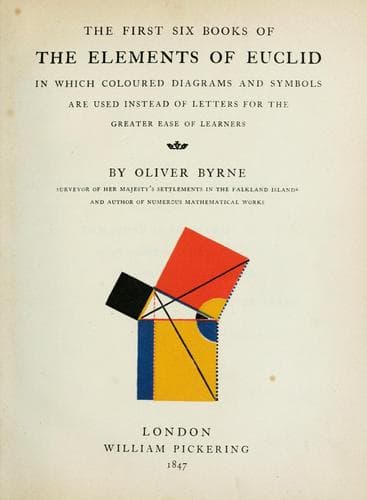
The First Six Books of the Elements of EuclidEuclid
Science
The First Six Books of the Elements of Euclid
Euclid
Euclid's Elements; Mathematics, Greek
Dem.—Let ABCD be a rectangle whose diagonal is AC. The triangle ABC will
describe a cone, and the rectangle a cylinder by revolving round AB. Take two points
E, F infinitely near each other in AC, and form two rectangles, EH, EK, by
drawing lines parallel to AD, AB. Now if O, O′ be the middle points of these
rectangles, it is evident that, when the whole figure revolves round AB, the
circumference of the circle described by O′ will ultimately be twice the circumference
of the circle described by O; and since the parallelogram EK is equal to EH
[I. xliii.], the solid described by EK (Cor. 1) will be equal to twice the solid
described by EH. Hence, if AC be divided into an indefinite number of equal
parts, and rectangles corresponding to EH, EK be inscribed in the triangles
ABC, ADC, the sum of the solids described by the rectangles in the triangle
ADC is equal to twice the sum of the solids described by the rectangles in
the triangle ABC—that is, the difference between the cylinder and cone
is equal to twice the cone. Hence the cylinder is equal to three times the
cone.
Or thus: We may regard the cone and the cylinder as limiting cases of a pyramid and prism
having the same base and altitude; and since (v. Cor. 2) the volume of a pyramid is one-third of
the volume of a prism, having the same base and altitude, the volume of the cone is one-third of the
volume of the cylinder.
Cor. 4.—If r be the radius of the base of a cone, and h its height,
Cor. 5.—The volume of a sphere is two-thirds of the volume of a circumscribed
cylinder.
Dem.—Let AB be the diameter of the semicircle which describes the sphere;
ABCD the rectangle which describes the cylinder. Take two points E, F indefinitely
near each other in the semicircle. Join EF, which will be a tangent, and produce it to
meet the diameter PQ perpendicular to AB in N. Let R be the centre. Join RE;
draw EG, FH, NL parallel to AB; and EI, FK parallel to PQ; and produce to
meet LN in M and L; and let O, O′ be the middle points of the rectangles EH,
EK.
Now the rectangle NG.GR = PG.GQ, because each is equal to GE2. Hence
NG : GP :: GQ : GR, or ME : IE :: RP + RG : RG. Now, denoting the radii of the
circles described by the points O, O′ by ρ, ρ′ respectively, we have ultimately ρ = GR
and ρ′ = (RP + RG). Hence ME : IE :: 2ρ′ : ρ; but ME : IE :: rectangle EL :
rectangle EK :: [I. xliii.] EH : EK;
∴ EH : EK :: 2ρ′ : ρ;
∴ 2πρ.EH = 2(2πρ′.EK).
Hence the solid described by EH equal twice the solid described by EK. Therefore
we infer, as in the last Cor., that the whole volume of the sphere is equal to twice the
difference between the cylinder and sphere. Therefore the sphere is two-thirds of the
cylinder.
Cor. 6.—If r be the radius of a sphere,
PROP. VII.—Theorem.
The surface of a sphere is equal to the convex surface of the circumscribed
cylinder.
Public-domain text, read in full here on John Shaqi.
Reviews
Reviews
No reviews yet
Be the first to share your thoughts on this work.
Elsewhere in the archive
Join the Discussion
Join the discussion
Sign in to leave a comment or review.
Sign InorCreate an account