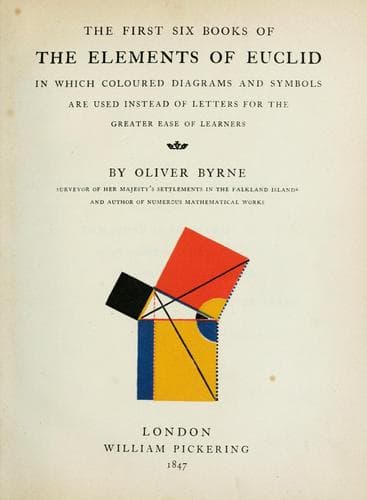
The First Six Books of the Elements of EuclidEuclid
Science
The First Six Books of the Elements of Euclid
Euclid
Euclid's Elements; Mathematics, Greek
In every plane there is one special line called the line at infinity. The point where any other line
in the plane cuts the line at infinity is called the point at infinity in that line. All other points in the
line are called finite points. Two lines in the plane which meet the line at infinity in the same point
are said to have the same direction, and two lines which meet it in different points to have
different directions. Two lines which have the same direction cannot meet in any finite point
[I. Axiom x.], and are parallel. Two lines which have different directions must intersect in some
finite point, since, if produced, they meet the line at infinity in different points. This is a
fundamental conception in Geometry, it is self-evident, and may be assumed as an Axiom
(see Observations on the Axioms, Book I.). Hence we may infer the following general
proposition:—“Any two lines in the same plane must meet in some point in that plane; that
is—(1) at infinity, when the lines have the same direction; (2) in some finite point,
when they have different directions.”—See Poncelet, Propriétés Projectives, page 52.
________________
NOTE B.
legendre’s and hamilton’s proofs of euclid, I. xxxii.
The discovery of the Proposition that “the sum of the three angles of a triangle is equal to two
right angles” is attributed to Pythagoras. Until modern times no proof of it, independent of the
theory of parallels, was known. We shall give here two demonstrations, each independent of that
theory. These are due to two of the greatest mathematicians of modern times—one, the
founder of the Theory of Elliptic Functions; the other, the discoverer of the Calculus of
Quaternions.
Legendre’s Proof.—Let ABC be a triangle, of which the side AC is the greatest. Bisect BC in
D. Join AD. Then AD is less than AC [I. xix. Ex. 5]. Now, construct a new triangle AB′C′,
having the side AC′ = 2AD, and AB′ = AC. Again, bisect B′C′ in D′, and form another triangle
AB′′C′′, having AC′′ = 2AD′, and AB′′ = AC′, &c. (1) The sum of the angles of the triangle
ABC = the sum of the angles of AB′C′ [I. xvi. Cor. 1] = the sum of the angles of AB′′C′′ = the
sum of the angles of AB′′′C′′′, &c. (2) The angle B′AC′ is less than half BAC; the angle
B′′AC′′ is less than half B′AC′, and so on; hence the angle B(n)A(n) will ultimately
become infinitely small. (3) The sum of the base angles of any triangle of the series is
equal to the angle of the preceding triangle (see Dem. I. xvi.). Hence, if the annexed
diagram represent the triangle AB(n+1)C(n+1), the sum of the base angles A and C(n+1) is
Public-domain text, read in full here on John Shaqi.
Reviews
Reviews
No reviews yet
Be the first to share your thoughts on this work.
Elsewhere in the archive
Join the Discussion
Join the discussion
Sign in to leave a comment or review.
Sign InorCreate an account