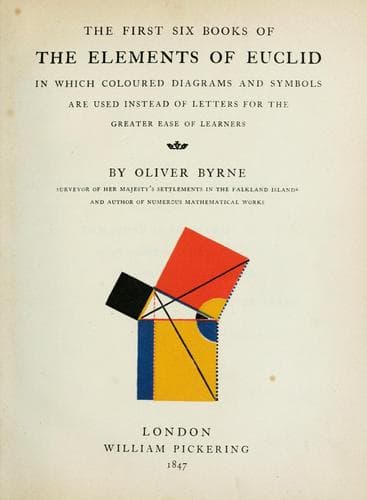
The First Six Books of the Elements of EuclidEuclid
Science
The First Six Books of the Elements of Euclid
Euclid
Euclid's Elements; Mathematics, Greek
equal to the angle B(n)C(n); and when n is indefinitely large, this angle is an infinitesimal; hence the
point B(n+1) will ultimately be in the line AC, and the angle AB(n+1)C(n+1) will become a
straight angle [I. Def. x.], that is, it is equal to two right angles; but the sum of the angles of
AB(n+1)C(n+1) is equal to the sum of the angles ABC. Hence the sum of the three angles of ABC
is equal to two right angles.
Hamilton’s Quaternion Proof.—Let ABC be the triangle. Produce BA to D, and make AD
equal to AC. Produce CB to E, and make BE equal to BD; finally, produce AC to F, and make
CF equal to CE. Denote the exterior angles thus formed by A′, B′, C′. Now let the leg AC of the
angle A′ be turned round the point A through the angle A′; then the point C will coincide
with D. Again, let the leg BD of the angle B′ be turned round the point B through the
angle B′, until BD coincides with BE; then the point D will coincide with E. Lastly, let
CE be turned round C, through the angle C′, until CE coincides with CF, and the
point E with F. Now, it is evident that by these rotations the point C has been brought
successively into the positions D, E, F; hence, by a motion of mere translation along the
line FC, the line CA can be brought into its former position. Therefore it follows, since
rotation is independent of translation, that the amount of the three rotations is equal to
one complete revolution round the point A; therefore A′ + B′ + C′ = four right angles;
but
A + A′ + B + B′ + C + C′ = six right angles [I. xiii.];
henceA + B + C = two right angles.
Observation.—The foregoing demonstration is the most elementary that was ever given of this
celebrated Proposition. I have reduced it to its simplest form, and without making any use of the
language of Quaternions. The same method of proof will establish the more general Proposition,
that the sum of the external angles of any convex rectilineal figure is equal to four right
angles.
Public-domain text, read in full here on John Shaqi.
Reviews
Reviews
No reviews yet
Be the first to share your thoughts on this work.
Elsewhere in the archive
Join the Discussion
Join the discussion
Sign in to leave a comment or review.
Sign InorCreate an account