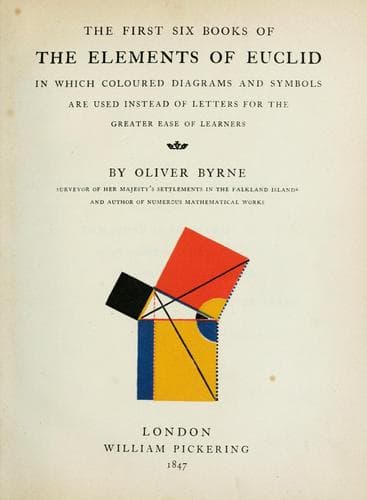
The First Six Books of the Elements of EuclidEuclid
Science
The First Six Books of the Elements of Euclid
Euclid
Euclid's Elements; Mathematics, Greek
These numbers are found thus: a′ is the geometric mean between a and A; that is, between .5
and .25, and A′ is the arithmetic mean between a′ and A, or between .3535533 and .25. Again, a′′ is
the geometric mean between a′ and A′; and A′′ the arithmetic mean between a′′ and A′. Proceeding
in this manner, we find a(13) = .3183099; A(13) = .3183099. Hence the area of a circle radius
unity, correct to seven decimal places, is equal to the reciprocal of .3183099; that is, equal
to 3.1415926; or the value of π correct to seven places of decimals is 3.1415926. The
number π is of such fundamental importance in Geometry, that mathematicians have
devoted great attention to its calculation. Mr. Shanks, an English computer, carried
the calculation to 707 places of decimals. The following are the first 36 figures of his
result:—
The result is here carried far beyond all the requirements of Mathematics. Ten decimals are
sufficient to give the circumference of the earth to the fraction of an inch, and thirty decimals would
give the circumference of the whole visible universe to a quantity imperceptible with the most
powerful microscope.
CONCLUSION.
In the foregoing Treatise we have given the Elementary Geometry of the Point,
the Line, and the Circle, and figures formed by combinations of these. But it is
important to the student to remark, that points and lines, instead of being distinct
from, are limiting cases of, circles; and points and planes limiting cases of spheres.
Thus, a circle whose radius diminishes to zero becomes a point. If, on the contrary,
the circle be continually enlarged, it may have its curvature so much diminished, that
any portion of its circumference may be made to differ in as small a degree
as we please from a right line, and become one when the radius becomes
infinite. This happens when the centre, but not the circumference, goes to
infinity.
THE END.
THIRD EDITION, Revised and Enlarged—3/6, cloth.
_____
A SEQUEL
TO THE
FIRST SIX BOOKS OF THE ELEMENTS OF EUCLID.
BY
JOHN CASEY, LL.D., F.R.S.,
Fellow of the Royal University of Ireland; Vice-President, Royal Irish Academy;
&c. &c.
________________
Dublin: Hodges, Figgis, & Co. London: Longmans, Green, & Co.
________________
EXTRACTS FROM CRITICAL NOTICES.
“Nature,” April 17, 1884.
Public-domain text, read in full here on John Shaqi.
Reviews
Reviews
No reviews yet
Be the first to share your thoughts on this work.
Elsewhere in the archive
Join the Discussion
Join the discussion
Sign in to leave a comment or review.
Sign InorCreate an account