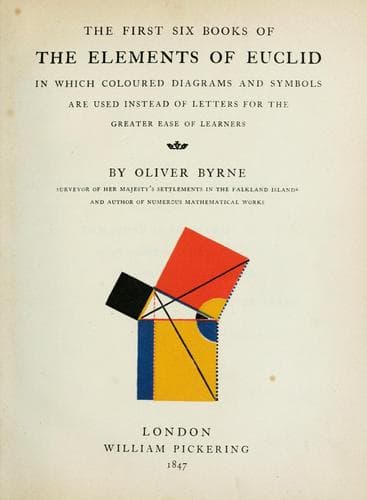
The First Six Books of the Elements of EuclidEuclid
Science
The First Six Books of the Elements of Euclid
Euclid
Euclid's Elements; Mathematics, Greek
Modern mathematicians denote the ratio of the circumference of a circle to its diameter by the
symbol π. Hence, if r denote the radius, the circumference will be 2πr; and, since the area of a circle
[VI. xx. Ex. 15] is equal to half the rectangle contained by the circumference and the radius, the
area will be πr2. Hence, if the area be known, the value of π will be known; and, conversely, if the
value of π be known, the area is known. On this account the determination of the value of π is
called “the problem of the quadrature of the circle,” and is one of the most celebrated in
Mathematics. It is now known that the value of π is incommensurable; that is, that it cannot be
expressed as the ratio of any two whole numbers, and therefore that it can be found only
approximately; but the approximation can be carried as far as we please, just as in extracting
the square root we may proceed to as many decimal places as may be required. The
simplest approximate value of π was found by Archimedes, namely, 22 : 7. This value is
tolerably exact, and is the one used in ordinary calculations, except where great accuracy is
required. The next to this in ascending order, viz. 355 : 113, found by Vieta, is correct to six
places of decimals. It differs very little from the ratio 3.1416 : 1, given in our elementary
books.
Several expeditious methods, depending on the higher mathematics, are known for calculating
the value of π. The following is an outline of a very simple elementary method for determining this
important constant. It depends on a theorem which is at once inferred from VI., Ex. 87, namely “If
a, A denote the reciprocals of the areas of any two polygons of the same number of sides inscribed
and circumscribed to a circle; a′, A′ the corresponding quantities for polygons of twice the number;
a′ is the geometric mean between a and A, and A′ the arithmetic mean between a′ and
A.” Hence, if a and A be known, we can, by the processes of finding arithmetic and
geometric means, find a′ and A′. In like manner, from a′, A′ we can find a′′, A′′ related
to a′, A′; as a′, A′ are to a, A. Therefore, proceeding in this manner until we arrive at
values a(n), A(n) that will agree in as many decimal places as there are in the degree of
accuracy we wish to attain; and since the area of a circle is intermediate between the
reciprocals of a(n) and A(n), the area of the circle can be found to any required degree of
approximation.
If for simplicity we take the radius of the circle to be unity, and commence with the inscribed
and circumscribed squares, we have
Public-domain text, read in full here on John Shaqi.
Reviews
Reviews
No reviews yet
Be the first to share your thoughts on this work.
Elsewhere in the archive
Join the Discussion
Join the discussion
Sign in to leave a comment or review.
Sign InorCreate an account