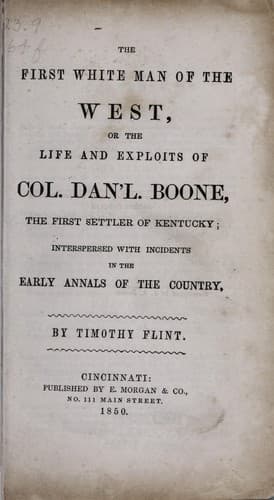
The First White Man of the West: Life and Exploits of Col. Dan'l. Boone, the First Settler of Kentucky;; Interspersed with Incidents in the Early Annals of the Country.Flint, Timothy
History
The First White Man of the West: Life and Exploits of Col. Dan'l. Boone, the First Settler of Kentucky;; Interspersed with Incidents in the Early Annals of the Country.
The commanding general, though he had been for some time enfeebled with
severe disease, acted with personal bravery, and delivered his orders
with judgment and self-possession. A charge was made upon the savages
with the bayonet: and they were driven from their covert with some loss,
a distance of four hundred yards. But as soon as the charge was
suspended, they returned to the attack. General Butler was mortally
wounded; the left of the right wing broken, and the artillerists killed
almost to a man. The guns were seized and the camp penetrated by the
enemy. A desperate charge was headed by Colonel Butler, although he was
severely wounded, and the Indians were again driven from the camp, and
the artillery recovered. Several charges were repeated with partial
success. The enemy only retreated, to return to the charge, flashed with
new ardor. The ranks of the troops were broken, and the men pressed
together in crowds, and were shot down without resistance. A retreat was
all that remained, to save the remnant of the army. Colonel Darke was
ordered to charge a body of savages that intercepted their retreat.
Major Clark, with his battalion, was directed to cover the rear. These
orders were carried into effect, and a most disorderly retreat
commenced. A pursuit was kept up four miles, when, fortunately for the
surviving Americans, the natural greediness of the savage appetite for
plunder, called back the victorious Indians to the camp, to divide the
spoils. The routed troops continued their flight to fort Jefferson,
throwing away their arms on the road. The wounded were left here, and
the army retired upon fort Washington.
In this fatal battle, fell thirty-eight commissioned officers, and five
hundred and ninety-three non-commissioned officers and privates.
Twenty-one commissioned officers, many of whom afterwards died of their
wounds, and two hundred and forty-two non-commissioned officers and
privates were wounded.
The savage force, in this fatal engagement, was led by a Mississago
chief, who had been trained to war under the British, during the
revolution. So superior was his knowledge of tactics, that the Indian
chiefs, though extremely jealous of him, yielded the entire command to
him; and he arranged and fought the battle with great combination of
military skill. Their force amounted to four thousand; and they stated
the Americans killed, at six hundred and twenty, and their own at
sixty-five; but it was undoubtedly much greater. They took seven pieces
of cannon and two hundred oxen, and many horses. The chief, at the close
of the battle, bade the Indians forbear the pursuit of the Americans, as
he said they had killed enough.
Public-domain text, read in full here on John Shaqi.
Reviews
Reviews
No reviews yet
Be the first to share your thoughts on this work.
Elsewhere in the archive
Join the Discussion
Join the discussion
Sign in to leave a comment or review.
Sign InorCreate an account