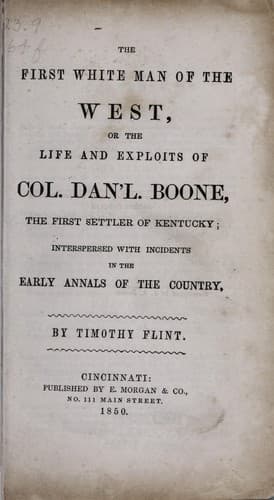
The First White Man of the West: Life and Exploits of Col. Dan'l. Boone, the First Settler of Kentucky;; Interspersed with Incidents in the Early Annals of the Country.Flint, Timothy
History
The First White Man of the West: Life and Exploits of Col. Dan'l. Boone, the First Settler of Kentucky;; Interspersed with Incidents in the Early Annals of the Country.
General Scott, with one thousand mounted volunteers from Kentucky, soon
after marched against a party of the victors, at St. Clair's fatal
field. He found the Indians rioting in their plunder, riding the oxen in
the glee of triumph, and acting as if the whole body was intoxicated.
General Scott immediately attacked them. The contest was short but
decisive. The Indians had two hundred killed on the spot. The cannon and
military stores remaining, were retaken, and the savages completely
routed. The loss of the Kentuckians was inconsiderable.
The reputation of the government was now committed in the fortunes of
the war. Three additional regiments were directed to be raised. On the
motion in congress for raising these regiments, there was an animated,
and even a bitter debate. It was urged on one hand, that the expense of
such a force would involve the necessity of severe taxation; that too
much power was thrown into the hands of the president; that the war had
been badly managed, and ought to have been entrusted to the militia of
the west, under their own officers; and with more force they urged that
no success could be of any avail, so long as the British held those
posts within our acknowledged limits, from which the savages were
supplied with protection, shelter, arms, advice, and instigation to the
war.
On the other hand, the justice of the cause, as a war of defence, and
not of conquest, was unquestionable. It was proved, that between 1783
and 1790, no less than one thousand five hundred people of Kentucky had
been massacred by the savages, or dragged into a horrid captivity; and
that the frontiers of Pennsylvania and Virginia had suffered a loss not
much less. It was proved that every effort had been made to pacify the
savages without effect. They showed that in 1790, when a treaty was
proposed to the savages at the Miami, they first refused to treat, and
then asked thirty days for deliberation. It was granted. In the interim,
they stated that not less than one hundred and twenty persons had been
killed and captured, and several prisoners roasted alive; at the term of
which horrors, they refused any answer at all to the proposition to
treat. Various other remarks were made in defence of the bill. It tried
the strength of parties in congress, and was finally carried.
Public-domain text, read in full here on John Shaqi.
Reviews
Reviews
No reviews yet
Be the first to share your thoughts on this work.
Elsewhere in the archive
Join the Discussion
Join the discussion
Sign in to leave a comment or review.
Sign InorCreate an account