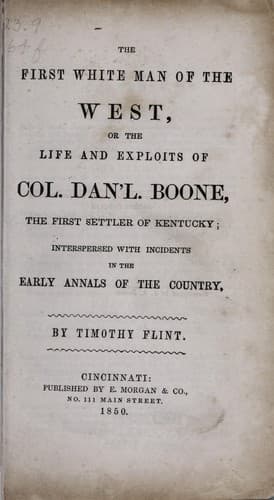
The First White Man of the West: Life and Exploits of Col. Dan'l. Boone, the First Settler of Kentucky;; Interspersed with Incidents in the Early Annals of the Country.Flint, Timothy
History
The First White Man of the West: Life and Exploits of Col. Dan'l. Boone, the First Settler of Kentucky;; Interspersed with Incidents in the Early Annals of the Country.
On the 8th of August, 1794, General Wayne reached the confluence of the
Au Glaize, and the Miami of the lakes. The richest and most extensive
settlements of the western Indians were at this place. It was distant
only about thirty miles from the post on the Miami, which the British;
had recently occupied. The whole strength of the enemy, amounting to
nearly two thousand warriors, was collected in the vicinity of that
post. The regulars of General Wayne were not much inferior in numbers. A
reinforcement of one thousand one hundred mounted Kentucky militia,
commanded by General Scott, gave a decided superiority to the American
force. The general was well aware that the enemy were ready to give him
battle, and he ardently desired it. But in pursuance of the settled
policy of the United States, another effort was made for the attainment
of peace, without the shedding of blood. The savages were exhorted by
those who were sent to them, no longer to follow the counsels of the bad
men at the foot of the Rapids, who urged them on to the war, but had
neither the power nor the inclination to protect them; that to listen to
the propositions of the government of the United States, would restore
them to their homes, and rescue them from famine. To these propositions
they returned only an evasive answer.
On the 20th of August, the army of General Wayne marched in columns. A
select battalion, under Major Price, moved as a reconnoitering force in
front. After marching five miles, he received so heavy a fire from the
savages, concealed as usual, that he was compelled to retreat. The
savages had chosen their ground with great judgment. They had moved into
a thick wood, in advance of the British works, and had taken a position
behind fallen timber, prostrated by a tornado. This rendered their
position almost inaccessible to horse. They were formed in three regular
lines, according to Indian custom, very much extended in front. Their
first effort was to turn the left flank of the American army.
The American legion was ordered to advance with trailed arms, and rouse
the enemy from his covert at the point of the bayonet, and then deliver
its fire. The cavalry, led by Captain Campbell, was ordered to advance
between the Indians and the river, where the wood permitted them to
penetrate, and charge their left flank. General Scott, at the head of
the mounted volunteers, was commanded to make a considerable circuit
and turn their right. These, and all the complicated orders of General
Wayne, were promptly executed. But such was the impetuosity of the
charge made by the first line of infantry, so entirely was the enemy
broken by it, and so rapid was the pursuit, that only a small part of
the second line, and of the mounted volunteers could take any part in
the action. In the course of an hour, the savages were driven more than
two miles, and within gun-shot of the British fort.
Public-domain text, read in full here on John Shaqi.
Reviews
Reviews
No reviews yet
Be the first to share your thoughts on this work.
Elsewhere in the archive
Join the Discussion
Join the discussion
Sign in to leave a comment or review.
Sign InorCreate an account