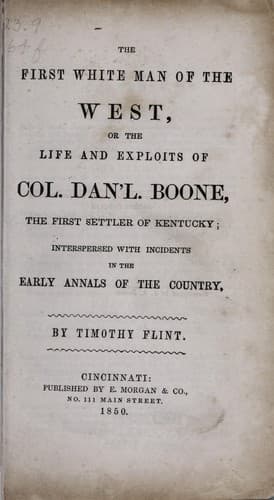
The First White Man of the West: Life and Exploits of Col. Dan'l. Boone, the First Settler of Kentucky;; Interspersed with Incidents in the Early Annals of the Country.Flint, Timothy
History
The First White Man of the West: Life and Exploits of Col. Dan'l. Boone, the First Settler of Kentucky;; Interspersed with Incidents in the Early Annals of the Country.
General Wayne remained three days on the field of battle, reducing the
houses and corn-fields, above and below the fort, and some of them
within pistol shot of it, to ashes. The houses and stores of Col. M'Kee,
an English trader, whose great influence among the savages had been
uniformly exerted for the continuance of the war, was burned among the
rest. Correspondence upon these points took place between General Wayne
and Major Campbell, who commanded the British fort. That of General
Wayne was sufficiently firm; and it manifested that the latter only
avoided hostilities with him, by acquiescing in the destruction of
British property within the range of his guns.
On the 28th the army returned to Au Glaize, destroying all the villages
and corn within fifty miles of the river. In this decisive battle, the
American loss, in killed and wounded, amounted to one hundred and seven,
including officers. Among those that fell, were Captain Campbell and
Lieutenant Towles. The general bestowed great and merited praise, for
their bravery and promptitude in this affair, to all his troops.
The hostility of the Indians still continuing, the whole country was
laid waste: and forts were erected in the heart of their settlements, to
prevent their return. This seasonable victory, and this determined
conduct on the part of the United States, rescued them from a general
war with all the nations north-west of the Ohio. The Six Nations had
manifested resentments, which were only appeased for the moment, by the
suspension of a settlement, which Pennsylvania was making at Presqu'
Isle, within their alleged limits. The issue of this battle dissipated
the clouds at once which had been thickening in that quarter. Its
influence was undoubtedly felt far to the south. The Indian inhabitants
of Georgia, and still farther to the south had been apparently on the
verge of a war, and had been hardly restrained from hostility by the
feeble authority of that state.
No incidents of great importance occurred in this quarter, until August
3d, of the next year when a definitive treaty was concluded by General
Wayne, with the hostile Indians north-west of the Ohio. By this treaty,
the destructive war which had so long desolated that frontier, was ended
in a manner acceptable to the United States. An accommodation was also
brought about with the southern Indians, notwithstanding the intrigues
of their Spanish neighbors. The regions of the Mississippi valley were
opened on all sides to immigration, and rescued from the dread of Indian
hostilities.
CHAPTER XIV.
Rejoicings on account of the peace--Boone indulges his propensity for
hunting--Kentucky increases in population--Some account of their
conflicting land titles--Progress of civil improvement destroying the
range of the hunter--Litigation of land titles--Boone loses his
lands--Removes from Kentucky to the Kanawha--Leaves the Kanawha and goes
to Missouri, where he is appointed Commandant.
Public-domain text, read in full here on John Shaqi.
Reviews
Reviews
No reviews yet
Be the first to share your thoughts on this work.
Elsewhere in the archive
Join the Discussion
Join the discussion
Sign in to leave a comment or review.
Sign InorCreate an account