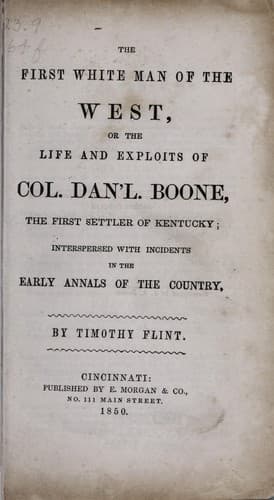
The First White Man of the West: Life and Exploits of Col. Dan'l. Boone, the First Settler of Kentucky;; Interspersed with Incidents in the Early Annals of the Country. — John Shaqi
The First White Man of the West: Life and Exploits of Col. Dan'l. Boone, the First Settler of Kentucky;; Interspersed with Incidents in the Early Annals of the Country.Flint, Timothy
History
The First White Man of the West: Life and Exploits of Col. Dan'l. Boone, the First Settler of Kentucky;; Interspersed with Incidents in the Early Annals of the Country.
They advanced into Kentucky so far, as to their imaginations with the
fresh and luxuriant beauty of its lawns, its rich cane-brakes and
flowering forests. To them it was a terrestrial paradise for it was
full of game. Deer, elk, bears, buffaloes, panthers, wolves, wild-cats,
and foxes, abounded in the thick tangles of the green cane; and in the
open woods, pheasants, partridges, and turkeys, were as plenty as
domestic fowls in the old settlements.
Such were the materials, from which these hunters, on their return
formed descriptions that fixed in the remembrance, and operated upon the
fancy of all who heard. A year after Finley's return, his love of
wandering led him into the vicinity of Daniel Boone. They met, and the
hearts of these kindred spirits at once warmed towards each other.
Finley related his adventures, and painted the delights of
_Kain-tuck-kee_--for such was its Indian name. Boone had but few
hair-breath escapes to recount, in comparison with his new companion.
But it can readily be imagined, that a burning sensation rose in his
breast, like that of the celebrated painter Correggio, when low-born,
untaught, poor and destitute of every advantage, save that of splendid
native endowment, he stood before the work of the immortal Raphael, and
said, "I too am a painter!" Boone's purpose was fixed. In a region, such
as Finley described, far in advance of the wearying monotony of a life
of inglorious toil, he would have space to roam unwitnessed, undisturbed
by those of his own race, whose only thought was to cut down trees, at
least for a period of some years. We wish not to be understood to laud
these views, as wise or just. In the order of things, however, it was
necessary, that men like Finley and Boone, and their companions, should
precede in the wilderness, to prepare the way for the multitudes who
would soon follow. It is probable, that no motives but those ascribed to
them, would have induced these adventurers to face the hardships and
extremes of suffering from exposure and hunger, and the peril of life,
which they literally carried in their hand.
No feeling, but a devotion to their favorite pursuits and modes of life,
stronger than the fear of abandonment, in the interminable and pathless
woods, to all forms of misery and death, could ever have enabled them to
persist in braving the danger and distress that stared them in the face
at every advancing step.
Finley was invited by Boone permanently to share the comfort of his
fire-side,--for it was now winter. It needs no exercise of fancy to
conjecture their subjects of conversation during the long evening. The
bitter wintry wind burst upon their dwelling only to enhance the
cheerfulness of the blazing fire in the huge chimneys, by the contrast
of the inclemency of nature without.
Public-domain text, read in full here on John Shaqi.
Reviews
Reviews
No reviews yet
Be the first to share your thoughts on this work.
Join the Discussion
Join the discussion
Sign in to leave a comment or review.
Sign InorCreate an account