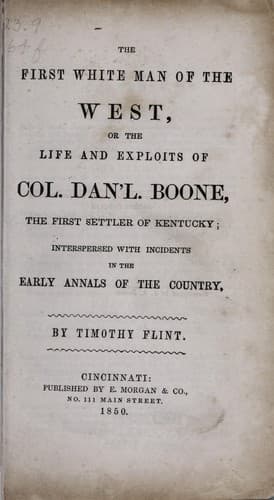
The First White Man of the West: Life and Exploits of Col. Dan'l. Boone, the First Settler of Kentucky;; Interspersed with Incidents in the Early Annals of the Country.Flint, Timothy
History
The First White Man of the West: Life and Exploits of Col. Dan'l. Boone, the First Settler of Kentucky;; Interspersed with Incidents in the Early Annals of the Country.
As this was an era in their adventures, and an omen of the abundance of
the vast regions of forests which they had descried from the summits of
the mountains, they halted, made a camp, and skinned the animals,
preserving the skins, fat, tongues, and choice pieces. No epicures ever
feasted higher than these athletic and hungry hunters, as they sat
around their evening fire, and commented upon the ease with which their
wants would be supplied in a country thus abounding with such animals.
After feasting again in the morning on the spoils of the preceding day,
and packing such parts of the animals as their probable necessities
suggested, they commenced their march; and in no great distance reached
Red river, a branch of the Cumberland. They followed the meanders of
this river for some miles, until they reached, on the 7th day of June,
Finley's former station, where his preceding explorations of the western
country had terminated.
Their journey to this point had lasted more than a month; and though the
circumstances in which they had made it, had been generally auspicious,
so long a route through unknown forests, and over precipitous mountains,
hitherto untrodden by white men, could not but have been fatiguing in
the extreme. None but such spirits could have sustained their hardships
without a purpose to turn back, and leave their exploration
unaccomplished.
They resolved in this place to encamp, and remain for a time sufficient
to recruit themselves for other expeditions and discoveries. The weather
had been for some time past, and still remained, rainy and unpleasant;
and it became necessary that their station should be of such a
construction, as to secure them a dry sleeping place from the rain. The
game was so abundant, that they found it a pleasure, rather than a
difficulty, to supply themselves with food. The buffaloes were seen like
herds of cattle, dispersed among the cane-brakes, or feeding on the
grass, or ruminating in the shade. Their skins were of great utility, in
furnishing them with moccasins, and many necessary articles
indispensable to their comfortable subsistence at their station.
What struck them with unfailing pleasure was, to observe the soil, in
general, of a fertility without example on the other side of the
mountains. From an eminence in the vicinity of their station, they could
see, as far as vision could extend, the beautiful country of Kentucky.
They remarked with astonishment the tall, straight trees, shading the
exuberant soil, wholly clear from any other underbrush than the rich
cane-brakes, the image of verdure and luxuriance, or tall grass and
clover. Down the gentle slopes murmured clear limestone brooks. Finley,
who had some touch of scripture knowledge, exclaimed in view of this
wilderness-paradise, so abundant in game and wild fowls, "This
wilderness blossoms as the rose; and these desolate places are as the
garden of God."
Public-domain text, read in full here on John Shaqi.
Reviews
Reviews
No reviews yet
Be the first to share your thoughts on this work.
Join the Discussion
Join the discussion
Sign in to leave a comment or review.
Sign InorCreate an account