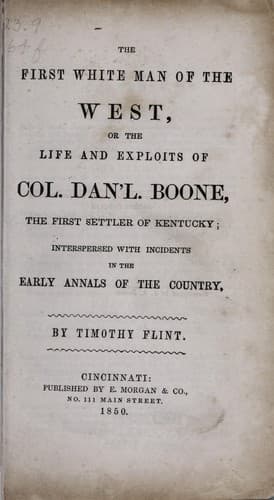
The First White Man of the West: Life and Exploits of Col. Dan'l. Boone, the First Settler of Kentucky;; Interspersed with Incidents in the Early Annals of the Country.Flint, Timothy
History
The First White Man of the West: Life and Exploits of Col. Dan'l. Boone, the First Settler of Kentucky;; Interspersed with Incidents in the Early Annals of the Country.
When a social band of this description had planted their feet on the
virgin soil, the first object was to fix on a spot, central to the most
fertile tract of land that could be found, combining the advantages
usually sought by the first settlers. Among these was, that the station
should be on the summit of a gentle swell, where pawpaw, cane, and wild
clover, marked exuberant fertility; and where the trees were so sparse,
and the soil beneath them so free from underbrush, that the hunter could
ride at half speed. The virgin soil, as yet friable, untrodden, and not
cursed with the blight of politics, party, and feud, yielded, with
little other cultivation than planting, from eighty to a hundred bushels
of maize to the acre, and all other edibles suited to the soil and
climate, in proportion.
The next thing, after finding this central nucleus of a settlement, was
to convert it into a _station_, an erection which now remains to be
described. It was a desirable requisite, that a station should in close
or command a flush limestone spring, for water for the settlement. The
contiguity of a salt lick and a sugar orchard, though not indispensable,
was a very desirable circumstance. The next preliminary step was to
clear a considerable area, so as to leave nothing within a considerable
distance of the station that could shelter an enemy from observation and
a shot. If a spring were not inclosed, or a well dug within, as an
Indian siege seldom lasted beyond a few days, it was customary, in
periods of alarm to have a reservoir of some sort within the station,
that should be filled with water enough to supply the garrison, during
the probable continuance of a siege. It was deemed a most important
consideration, that the station should overlook and command as much of
the surrounding country as possible.
The form was a perfect parallelogram, including from a half to a whole
acre. A trench was then dug four or five feet deep, and large and
contiguous pickets planted in this trench, so as to form a compact wall
from ten to twelve feet high above the soil. The pickets were of hard
and durable timber, about a foot in diameter. The soil about them was
rammed hard. They formed a rampart beyond the power of man to leap,
climb, or by unaided physical strength to overthrow. At the angles were
small projecting squares, of still stronger material and planting,
technically called _flankers_, with oblique port-holes, so as that the
sentinel within could rake the external front of the station, without
being exposed to shot from without. Two folding gates in the front and
rear, swinging on prodigious wooden hinges, gave egress and ingress to
men and teams in times of security.
Public-domain text, read in full here on John Shaqi.
Reviews
Reviews
No reviews yet
Be the first to share your thoughts on this work.
Elsewhere in the archive
Join the Discussion
Join the discussion
Sign in to leave a comment or review.
Sign InorCreate an account