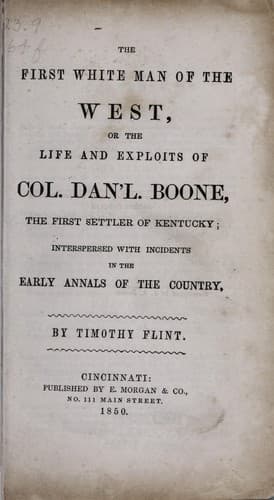
The First White Man of the West: Life and Exploits of Col. Dan'l. Boone, the First Settler of Kentucky;; Interspersed with Incidents in the Early Annals of the Country.Flint, Timothy
History
The First White Man of the West: Life and Exploits of Col. Dan'l. Boone, the First Settler of Kentucky;; Interspersed with Incidents in the Early Annals of the Country.
In periods of alarm a trusty sentinel on the roof of the building was so
stationed, as to be able to descry every suspicious object while yet in
the distance. The gates were always firmly barred by night; and
sentinels took their alternate watch, and relieved each other until
morning. Nothing in the line of fortification can be imagined more easy
of construction, or a more effectual protection against a savage enemy,
than this simple erection. Though the balls of the smallest dimensions
of cannon would have swept them away with ease, they were proof against
the Indian rifle, patience, and skill. The only expedient of the red men
was to dig under them and undermine them, or destroy them by fire; and
even this could not be done without exposing them to the rifles of the
flankers. Of course, there are few recorded instances of their having
been taken, when defended by a garrison, guided by such men as Daniel
Boone.
Their regular form, and their show of security, rendered these walled
cities in the central wilderness delightful spectacles in the eye of
immigrants who had come two hundred leagues without seeing a human
habitation. Around the interior of these walls the habitations of the
immigrants arose, and the remainder of the surface was a clean-turfed
area for wrestling and dancing, and the vigorous and athletic amusements
of the olden time. It is questionable if heartier dinners and profounder
sleep and more exhilarating balls and parties fall to the lot of their
descendants, who ride in coaches and dwell in mansions. Venison and wild
turkeys, sweet potatoes and pies, smoked on their table; and persimmon
and maple beer, stood them well instead of the poisonous whisky of their
children.
The community, of course, passed their social evenings together; and
while the fire blazed bright within the secure square, the far howl of
wolves, or even the distant war-whoop of the savages, sounded in the ear
of the tranquil in-dwellers like the driving storm pouring on the
sheltering roof above the head of the traveller safely reposing in his
bed; that is, brought the contrast of comfort and security with more
home-felt influence to their bosom.
Such a station was Bryant's, no longer ago than 1782. It was the nucleus
of the settlements of that rich and delightful country, of which at
present Lexington is the centre. There were but two others of any
importance, at this time north of Kentucky river. It was more open to
attack than any other in the country. The Miami on the north, and the
Licking on the south of the Ohio, were long canals, which floated the
Indian canoes from the northern hive of the savages, between the lakes
and the Ohio, directly to its vicinity.
Public-domain text, read in full here on John Shaqi.
Reviews
Reviews
No reviews yet
Be the first to share your thoughts on this work.
Elsewhere in the archive
Join the Discussion
Join the discussion
Sign in to leave a comment or review.
Sign InorCreate an account