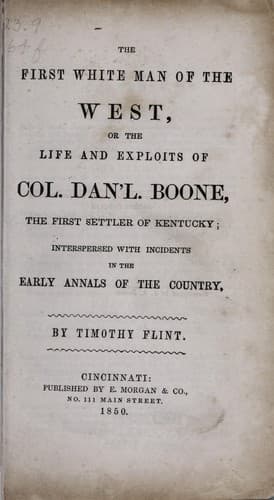
The First White Man of the West: Life and Exploits of Col. Dan'l. Boone, the First Settler of Kentucky;; Interspersed with Incidents in the Early Annals of the Country.Flint, Timothy
History
The First White Man of the West: Life and Exploits of Col. Dan'l. Boone, the First Settler of Kentucky;; Interspersed with Incidents in the Early Annals of the Country.
The chief, meanwhile, at intervals of about three hours, came out at the
head of his company, raised the war-whoop, and marched round the red
war-pole, holding in his right hand the pine or cedar boughs, on which
the scalps were attached, waving them backward and forward, and then
returned again. To these ceremonies they conformed without the slightest
interruption, during the whole three days' purification. To proceed with
the whole details of the ceremony to its close, would be tedious. We
close it, only adding, that a small twig of the evergreen was fixed upon
the roof of each one of their cabins, with a fragment of the scalps
attached to it, and this, as it appeared, to appease the ghosts of their
dead. When Boone asked them the meaning of all these long and tedious
ceremonies, they answered him by a word which literally imports "holy."
The leader and his waiter kept apart and continued the purification
three days longer, and the ceremony closed.
He observed, that when their war-parties returned from an expedition,
and had arrived near their village, they followed their file leader, in
what is called _Indian file_, one by one, each a few yards behind the
other, to give the procession an appearance of greater length and
dignity. If the expedition had been unsuccessful, and they had lost any
of their warriors, they returned without ceremony and in noiseless
sadness. But if they had been successful, they fired their guns in
platoons, yelling, whooping, and insulting their prisoners, if they had
made any. Near their town was a large square area, with a war-pole in
the centre, expressly prepared for such purposes. To this they fasten
their prisoners. They then advance to the house of their leader,
remaining without, and standing round his red war-pole, until they
determine concerning the fate of their prisoner. If any prisoner should
be fortunate enough to break from his pinions, and escape into the house
of the chief medicine man, or conductor of the powow, it is an
inviolable asylum, and by immemorial usage, the refugee is saved from
the fire.
Public-domain text, read in full here on John Shaqi.
Reviews
Reviews
No reviews yet
Be the first to share your thoughts on this work.
Elsewhere in the archive
Join the Discussion
Join the discussion
Sign in to leave a comment or review.
Sign InorCreate an account