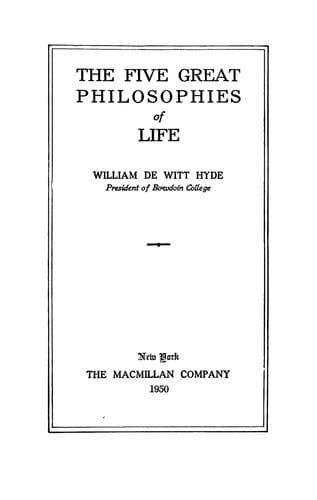
The Five Great Philosophies of LifeHyde, William De Witt
Philosophy
The Five Great Philosophies of Life
Hyde, William De Witt
Ethics; Philosophy, Ancient
"The adequately egoistic individual retains those powers which make
altruistic activities possible. The individual who is inadequately
egoistic loses more or less of his ability to be altruistic. The truth
of the one proposition is self-evident; and the truth of the other is
daily forced on us by examples. Note a few of them. Here is a mother
who, brought up in the insane fashion usual among the cultivated, has a
physique not strong enough for suckling her infant, but who, knowing
that its natural food is the best, and anxious for its welfare,
continues to give milk for a longer time than her system will bear.
Eventually the accumulating reaction tells. There comes exhaustion
running, it may be, into illness caused by depletion; occasionally
ending in death, and often entailing chronic weakness. She becomes,
perhaps for a time, perhaps permanently, incapable of carrying on
household affairs; her other children suffer from the loss of maternal
attention; and where the income is small, payments for nurse and doctor
tell injuriously on the whole family. Instance, again, what not
unfrequently happens with the father. Similarly prompted by a high sense
of obligation, and misled by current moral theories into the notion that
self-denial may rightly be carried to any extent, he daily continues his
office work for long hours regardless of hot head and cold feet; and
debars himself from social pleasures, for which he thinks he can afford
neither time nor money. What comes of this entirely unegoistic course?
Eventually a sudden collapse, sleeplessness, inability to work. That
rest which he would not give himself when his sensations prompted he has
now to take in long measure. The extra earnings laid by for the benefit
of his family are quickly swept away by costly journeys in aid of
recovery and by the many expenses which illness entails. Instead of
increased ability to do his duty by his offspring there comes now
inability. Lifelong evils on them replace hoped-for goods. And so is it,
too, with the social effects of inadequate egoism. All grades furnish
examples of the mischiefs, positive and negative, inflicted on society
by excessive neglect of self. Now the case is that of a labourer who,
conscientiously continuing his work under a broiling sun, spite of
violent protests from his feelings, dies of sunstroke; and leaves his
family a burden to the parish. Now the case is that of a clerk whose
eyes permanently fail from overstraining, or who, daily writing for
hours after his fingers are painfully cramped, is attacked with
'scrivener's palsy,' and, unable to write at all, sinks with aged
parents into poverty which friends are called on to mitigate.
"And now the case is that of a man devoted to public ends who,
shattering his health by ceaseless application, fails to achieve all he
might have achieved by a more reasonable apportionment of his time
between labour on behalf of others, and ministration to his own needs."
Public-domain text, read in full here on John Shaqi.
Reviews
Reviews
No reviews yet
Be the first to share your thoughts on this work.
Join the Discussion
Join the discussion
Sign in to leave a comment or review.
Sign InorCreate an account