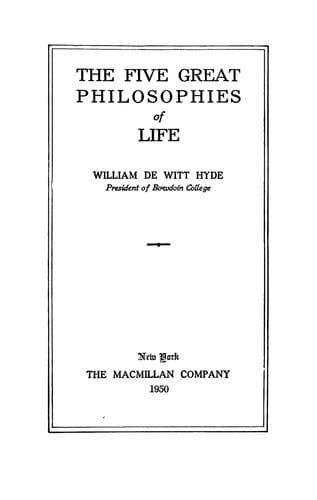
The Five Great Philosophies of LifeHyde, William De Witt
Philosophy
The Five Great Philosophies of Life
Hyde, William De Witt
Ethics; Philosophy, Ancient
pleasantly diverted, without effort or exertion on your part. If the
glee club can be brought around to sing some jolly songs, if a funny man
can be found to tell amusing stories, you have the happy mean; that is,
just enough recreation to put you in condition for a night's sound
sleep, and bring you to the contest on the morrow in prime physical and
mental condition.
Aristotle, in his doctrine of the mean, is simply telling us that this
problem of the athlete on the night before the contest is the personal
problem of us all every day of our lives.
How late shall the student study at night? Shall he keep on until past
midnight year after year? If he does, he will undermine his health, lose
contact with society, and defeat those ends of social usefulness which
ought to be part of every worthy scholar's cherished end. On the other
hand, shall he fritter away all his evenings with convivial fellows, and
the society butterflies? Too much of that sort of thing would soon put
an end to scholarship altogether. His problem is to find that amount of
study which will keep him sensitively alive to the latest problems of
his chosen subject; and yet not make all his acquisitions comparatively
worthless either through broken health, or social estrangement from his
fellow-men. How rare and precious that mean is, those of us who have to
find college professors are well aware. It is easy to find scores of men
who know their subject so well that they know nothing and nobody else
aright. It is easy to find jolly, easy-going fellows who would not
object to positions as college professors. But the man who has enough
good fellowship and physical vigour to make his scholarship attractive
and effective, and enough scholarship to make his vigour and good
fellowship intellectually powerful and personally stimulating,--he is
the man who has hit the Aristotelian mean; he is the man we are all
after; he is the man whom we would any of us give a year's salary to
find.
Public-domain text, read in full here on John Shaqi.
Reviews
Reviews
No reviews yet
Be the first to share your thoughts on this work.
Elsewhere in the archive
Join the Discussion
Join the discussion
Sign in to leave a comment or review.
Sign InorCreate an account